- The Chinese province plans to put industrial robot output among the country’s leaders by 2030 and build a nationally influential robotics cluster by 2035
- Anhui will earmark 500 million yuan a year from 2027 to 2030 for robotics R&D, commercialization and talent development
Anhui has set a two-stage target to build up its robotics industry, aiming to rank among China’s leading provinces in industrial and humanoid robot production by 2030 and establish a nationally influential robotics cluster by 2035.
The provincial government announced the targets and supporting policies on September 28, including 500 million yuan ($74.5 million) in annual government funding from 2027 to 2030 for key robotics technologies, commercial applications and talent development.
The scale of the annual funding commitment underscores the province’s ambition to make robotics a new industrial growth engine after new-energy vehicles, market analysts say.
The policy also encourages robotics companies to pursue global acquisitions and supply-chain integration, while supporting automakers in expanding into robotics.
Building on industrial strengths
The strategy builds on Anhui’s existing strengths in vehicle manufacturing and auto components. The province has a broad supply chain covering motors, reducers and sensors, many of which are also core components of humanoid robots.
Anhui is not starting from scratch. Hefei is home to research platforms including the University of Science and Technology of China’s humanoid robotics institute.
Meanwhile, the second-largest city Wuhu has developed industrial robot production capabilities around companies such as Efort (埃夫特).
Several companies and research institutions in Anhui have already introduced humanoid robots, including the University of Science and Technology of China, Chery and JAC.
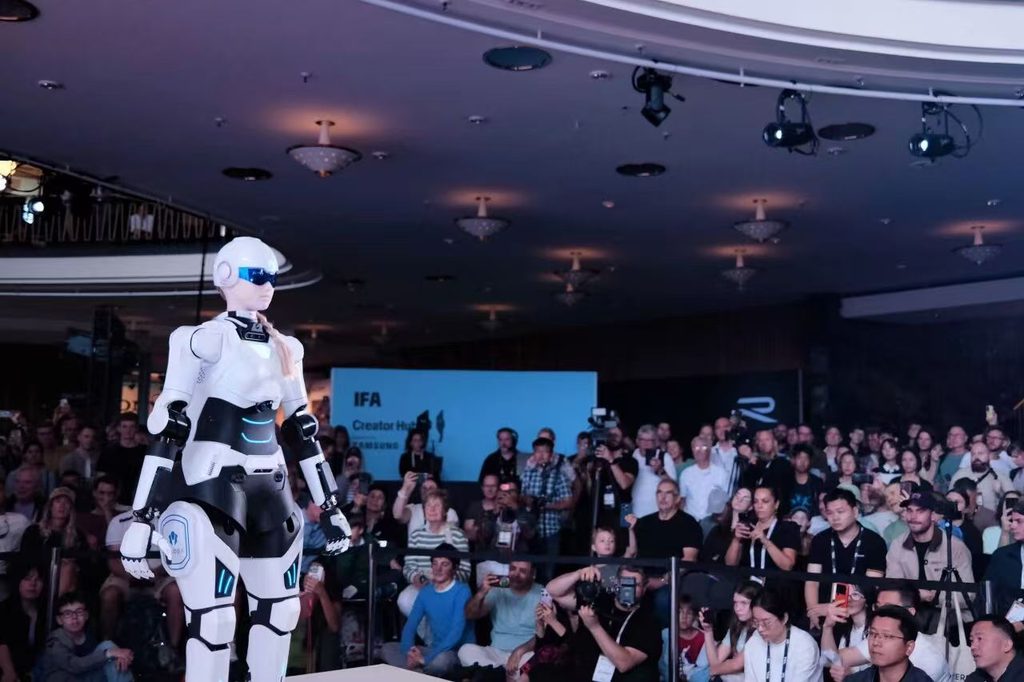
Some of their models were showcased at the recent 2026 World Manufacturing Convention, highlighting the province’s progress in humanoid robot development.
Auto expertise feeds robotics
The push also reflects the growing overlap between smart vehicles and humanoid robots.
Automakers such as Chery and JAC Motors already have teams working on perception, algorithms and autonomous decision-making, while their manufacturing and component supply chains can be adapted for robotics.
Anhui also has established capabilities in areas including displays, integrated circuits and artificial intelligence, giving robot makers access to nearby suppliers of vision sensors, computing chips and other components.
Header image generated by Tencent Yuanbao AI