
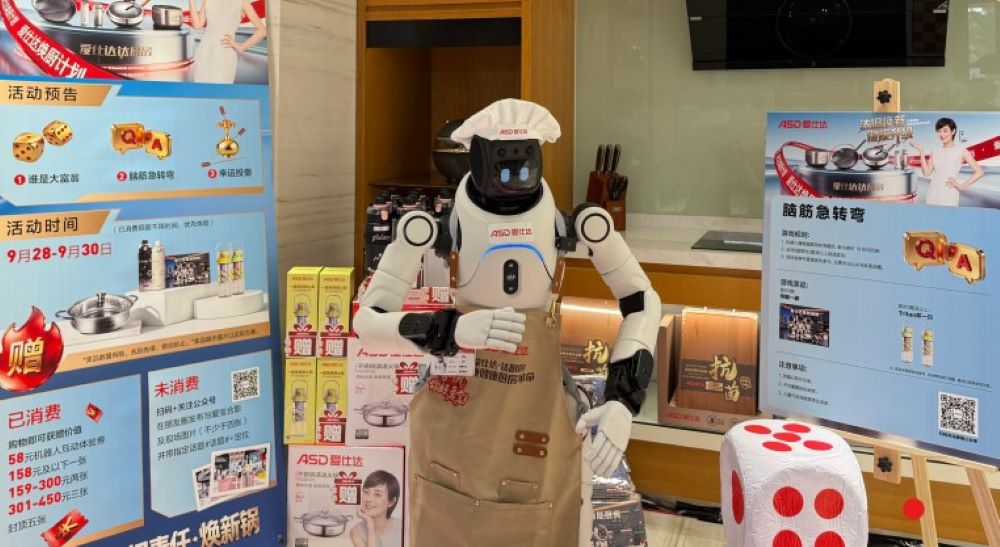
- The three-day trial generated 2.23 million yuan in sales across 100 ASD stores, according to the companies
- But without a control group, the contribution from robots remains difficult to separate from holiday shopping demand
A three-day trial deploying 100 AgiBot (智元机器人) humanoid robots in 100 of cookware brand ASD’s stores coincided with a 39% average increase in store sales during China’s National Day holiday, according to Chinese media reports.
The Lingxi X2 robots helped generate about 2.23 million yuan ($333,226) in sales across the stores, AgiBot said in a statement.
They logged 30 hours of on-duty time, 13,400 customer interactions across Shanghai, Jiangsu’s Wuxi and Zhejiang’s Wenling, and 214,714 steps, the Shanghai-based robot startup said in an official WeChat post.
Its cooperation with ASD, a major home appliance maker, began in July, when the two firms signed a cooperation agreement covering real-world data collection, model training, robot manufacturing and in-store deployment.
On September 28, 100 Lingxi X2 humanoid robots began a three-day livestream across 100 ASD stores in three cities, with broadcasts running from 10 a.m. to 8 p.m. each day.
The headline growth figure, however, leaves a key question unanswered: how much of the gain was actually driven by the robots?
A sales lift without a control group
ASD’s own disclosures offer a useful point of comparison. As of September 6, its embodied-intelligence robotics business had generated just 137,200 yuan in revenue.
The company described the business as being at an early stage, with uncertainty around technological development, project deployment and commercialization.
The figures measure different things. The 137,200 yuan represents revenue from ASD’s robotics business, while the 2.23 million yuan refers to sales at stores where robots were deployed.
The latter includes purchases made after customers were attracted into a store or engaged by a robot, even if a human salesperson ultimately closed the sale.
The trial also ran during China’s National Day holiday, a peak period for offline shopping. Some customers may have visited specifically to see the robots, while stores may have been benefiting from seasonal demand regardless of the deployment.
Without comparable stores operating over the same period without robots, it is difficult to establish how much of the 39% increase was incremental.
Neither company has disclosed a control-group comparison or a breakdown of sales directly attributable to robot interactions.
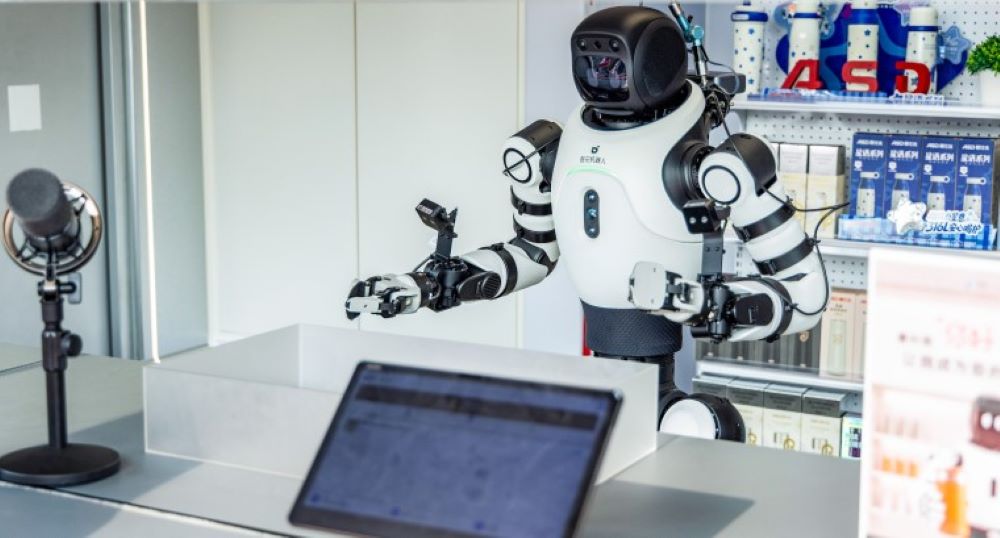
Robots handle the front end
Lyu Suhe (吕苏荷), vice-president of AgiBot’s Lingxi product line, described the robots as resembling “a newly hired salesperson”: their scripted interactions are becoming natural, but they remain some way from matching top-performing human staff.
ASD Chairman Chen Helin (陈合林) offered a more restrained description of the division of labor.
Robots would provide “breadth,” handling frequent and standardized front-end interactions, while human salespeople would provide “depth” through more detailed customer service and product advice, he said.
That model is plausible: robots can greet visitors, explain basic product information and direct shoppers to items, freeing human staff to focus on more complex sales.
But the three-day trial does not yet establish how much the approach improves sales over time. The next step is to measure performance after the novelty wears off, ideally against comparable stores without robots.
Until then, the 39% increase is an encouraging result from a short promotional trial, not proof that humanoid robots can deliver a sustained sales lift.
Header image credit: AgiBot official WeChat
-1.jpg)
