
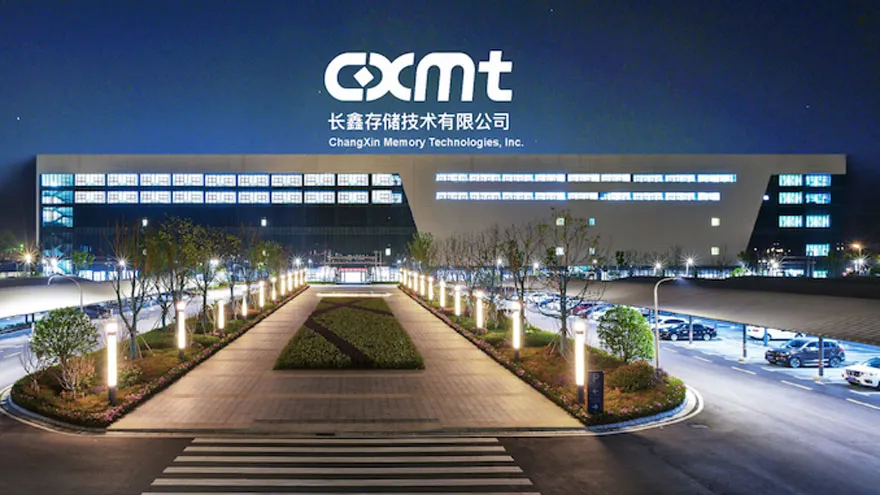
- CXMT moves into risk production of LPDDR6 as AI devices fuel demand for faster memory
- Next-generation DRAM development narrows China’s gap with global chipmakers
Chinese memory maker CXMT (长鑫存储) has made significant progress on its next-generation LPDDR6 memory project, entering the risk production stage and moving closer to commercial deployment, Chinese media reported on August 6.
This move comes as it seeks to narrow the technology gap with global memory leaders including Samsung Electronics, SK Hynix and Micron.
According to domestic media reports, CXMT is currently sending samples to major smartphone manufacturers and computing platform companies for validation.
If prototype testing meets expectations, its domestically developed LPDDR6 chips could enter large-scale production within the year.
The company’s track record of rapidly expanding manufacturing capacity could further shorten the transition from trial production to mass production, potentially compressing the ramp-up period to only several weeks after successful validation.
Closing the gap
The development marks a major step forward for China’s memory industry.
In previous generations, domestic memory suppliers often lagged international competitors by more than six months in adopting advanced standards.

CXMT’s LPDDR6 trial production suggests Chinese memory technology has significantly narrowed the gap in low-power, high-bandwidth memory.
The move comes as competition in the semiconductor industry increasingly shifts toward AI-era components, where faster memory and greater energy efficiency have become critical for smartphones, PCs and edge AI devices.
Faster and more efficient
The first batch of CXMT’s LPDDR6 chips reportedly reaches data rates of 12.8 gigabits per second (Gbps), above the LPDDR6 baseline specification of 10.7 Gbps.
By comparison, current LPDDR5X memory reaches around 10.7 Gbps only under extreme overclocking conditions. CXMT’s new chips could therefore deliver roughly 20% higher bandwidth performance under standard operating conditions.
Each chip has a capacity of 16Gb, equivalent to 2GB, and uses a package-on-package (PoP) design. The technology vertically stacks memory and processors through a 1,295-pin BGA package, helping reduce space consumption in mobile devices such as smartphones.

LPDDR6 represents a broader architectural upgrade rather than a routine performance refresh. Compared with LPDDR5, the new standard significantly improves transmission speed and bandwidth, allowing mobile devices to handle AI workloads and large-scale applications more efficiently.
At the same time, redesigned channel architecture improves data throughput while reducing power consumption by more than 20%. The standard also integrates mandatory error correction features to improve system stability under heavy workloads.
Built for AI devices
The push comes as on-device AI models rapidly expand, increasing demand for higher memory bandwidth in smartphones and AI PCs.
With its 12.8 Gbps performance, CXMT’s LPDDR6 could help reduce bottlenecks in local AI inference, where large models require faster movement of data between memory and processors.
For China’s semiconductor supply chain, securing a domestic next-generation mobile memory solution has strategic importance, reducing reliance on overseas suppliers in a critical component category.
A pragmatic catch-up
Samsung, SK Hynix and Micron are reportedly developing higher-specification LPDDR6 products capable of reaching 14.4 Gbps. However, CXMT’s 12.8 Gbps version may better match current market requirements for commercial deployment.
For China’s memory industry, the immediate priority is not necessarily surpassing global leaders in peak specifications, but achieving stable production and reliable supply in mainstream performance segments.
CXMT’s LPDDR6 progress reflects a broader shift in China’s semiconductor development — from catching up with established technologies to competing in the next generation of global memory markets.

.jpg)