- The Suzhou tech company is consolidating more than 200 business units into four core areas after a year of aggressive expansion
- Its retreat from cars, smartphones and other ventures highlights the risks of stretching a profitable core business too far
Dreame Technology (追觅科技), a Suzhou-based consumer electronics manufacturer, is pulling back from an aggressive expansion drive, consolidating resources around four core businesses — smart home, outdoor living, smart mobility and embodied intelligence — according to a strategic update released August 25.
The move marks a sharp reversal for the Suzhou-based tech startup, which only months ago was pursuing ambitions ranging from luxury cars to smartphones, chips and drones.
From global robot-vacuum leader to sprawling conglomerate
Dreame’s core robot-vacuum business was still riding high earlier this year. In the first quarter, the company accounted for 23.7% of global robot-vacuum unit sales and 28% of sales revenue, ranking No. 1 on both measures, according to data from IDC.
Its products led market share in 30 countries.
But that success was accompanied by rapid, even reckless diversification. Early this year, Dreame announced plans to expand into more than 200 business units, spanning automobiles, smartphones, chips, drones, consumer toys and even bubble tea shops.
The most ambitious bet was automobiles. In August 2025, founder Yu Hao (俞浩) unveiled plans to build cars, saying the first model would rival the Bugatti Veyron and target mass production in 2027.
Dreame assembled a nearly 1,000-person automotive team and planned multiple product lines, including supercars and flagship SUVs, with total investment expected to exceed 30 billion yuan ($4.46 billion).
The supercar dream hits the brakes
Less than a year later, the company’s automotive ambitions have been sharply scaled back.
The so-called “Starlight Project” (星空计划) team has reportedly been reduced to about 100 employees, with more than two-thirds of workstations left vacant.
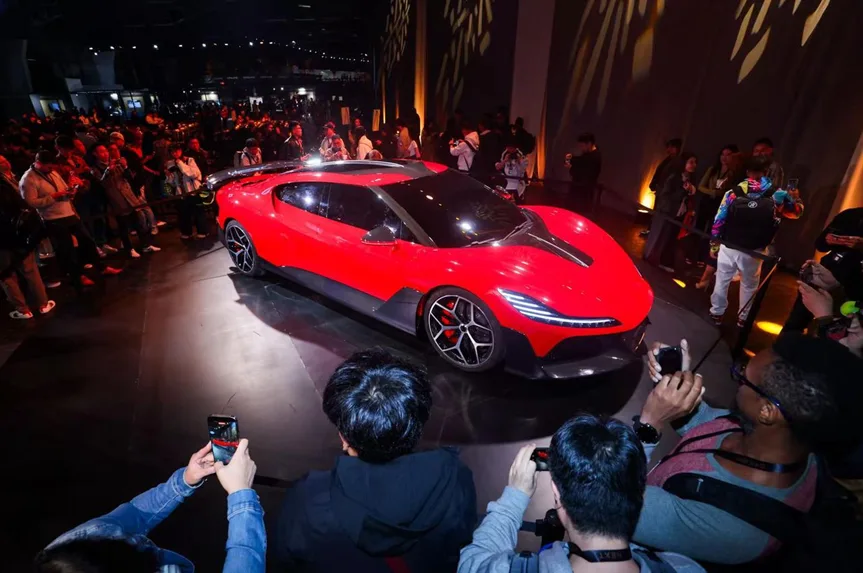
A red Nebula NEXT 01 concept car once prominently displayed by the company is now covered, while employees have said the prototype was not actually driveable and cost about 3 million yuan to build.
The automotive business is no longer operated as a standalone unit. Instead, it has been folded into Dreame’s industrial research institute, where only underlying technology development will continue.
The smartphone business has followed a similar path. Dreame once unveiled a $30,000 phone featuring 24-karat gold customization, but its smartphone R&D team has since been dismantled.
Funding model loses its fuel
Dreame’s expansion was fueled by a financing model that combined roughly 20% of its own capital with 80% from local state-backed investors.
That model came under pressure after a central government directive tightened rules governing local state-owned capital investment.
Dreame gradually stopped providing internal funding from March and ended the capital injections entirely in June, according to reports.
Its corporate venture arm, Skyworks (天空工场), had remained highly active earlier in the year. It had invested in 57 companies and managed 5.33 billion yuan in registered fund capital by the first half of 2026.
But public disclosures of new investments became scarce from May onward, coinciding with Dreame’s broader restructuring. Only two new funds were registered between July and August, compared with 29 during the first half of the year.
A costly lesson in strategic focus
The retreat comes after Dreame’s attempt to turn a highly profitable core business into a sprawling technology empire.
Founder Yu Hao had previously pushed more than 20,000 employees to establish social-media accounts and produce hundreds of videos in an aggressive marketing drive.
The company’s latest restructuring will consolidate more than 200 business units into four main divisions, effectively reversing much of the expansion undertaken over the past year.
The shift offers a broader lesson for China’s technology industry. A company can have a globally competitive core business and still struggle when its ambitions expand faster than its capital, management capacity and technological capabilities.
For Dreame, the question now is whether its return to four core businesses can restore the discipline and profitability that powered its rise.
More importantly, it will come down to whether the company can resist the temptation to chase another grand narrative before its existing businesses are strong enough to support it.