- Yangtze River Delta startups in embodied AI, photonics, world models and quantum computing raised fresh funding
- New capital will support foundation models, optical chips, humanoid robots and next-generation quantum hardware
Zigleap AI raises snags angel+ funding to deepen bet on embodied AI
Hangzhou-based embodied-AI startup Zigleap AI (斜跃智能) has raised hundreds of millions of yuan in an Angel+ round backed by Linear Capital, Peakvest, Rhein Capital and Hidden Hill Capital, among other investors.
Founded in February 2026 by Chen Wei (陈伟), Li Auto’s former chief AI scientist, and Zhang Xiao (张骁), the automaker’s former president of a product line, the company was previously known as Slash Robotics and has now changed its English name to Zigleap AI.
Its core team spans large-model algorithms, AI infrastructure, robotic motion control and product mass production.
Zigleap is targeting the home as its first major application scenario. It has proposed a new embodied-foundation-model paradigm called “Duplex Reasoning,” designed to maintain a two-way channel between humans and robots during perception, understanding and task execution.
Under the approach, users can interrupt and correct a conversation at any time, while the robot can dynamically adjust its action goals as tasks evolve.
The latest funding will support embodied-foundation-model training, computing and data infrastructure, team expansion, as well as the development and scenario testing of home robots.
PhotonNex completes new equity funding to advance optical interconnects
Shanghai-based optical-interconnect startup PhotonNex (芯界光核) has raised hundreds of millions of yuan in a new financing round, led by Hua Capital and Addor Capital.
Welight Capital, Zizhu National Hi-Tech Industrial Development Investment, Tsingstone Capital and Hanhui Capital also participated.
Founded in January 2026, PhotonNex was established by researchers from Shanghai Jiao Tong University’s State Key Laboratory of Optical Communication Technologies and industry veterans with experience in commercializing photonics technologies.
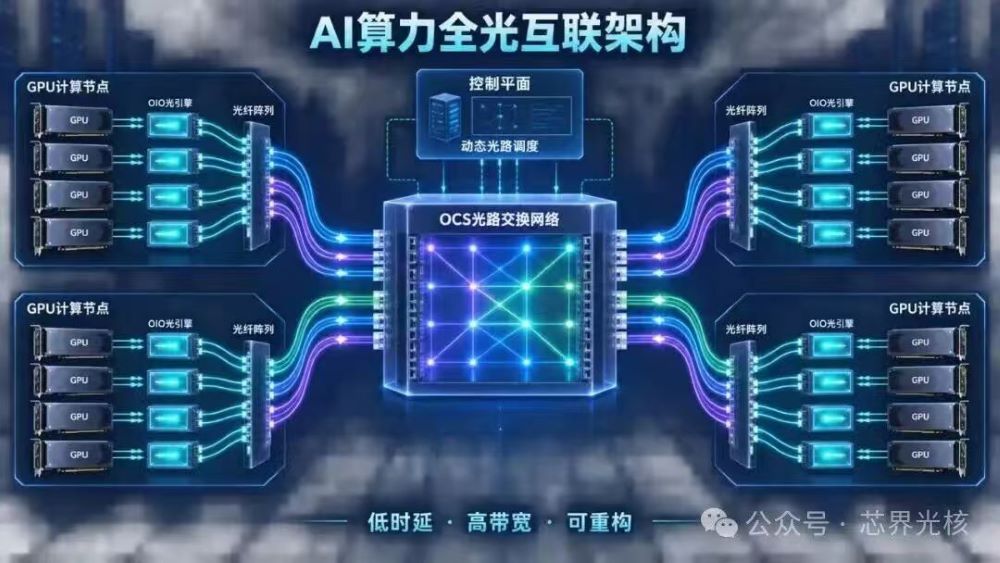
The company is developing its Photonic Nexus all-optical interconnect platform for AI computing clusters and next-generation intelligent computing centers.
Its offering spans silicon photonic chips, optical engines and optical switching systems, providing an end-to-end optical-interconnect architecture.
Beyond optical input/output (OIO), PhotonNex is introducing optical circuit switching (OCS) based on silicon photonics rather than the conventional MEMS approach.
It has completed development of a 32×32 silicon-based OCS chip and is now working on products with 64 ports and beyond.
The latest funding will primarily support chip tape-outs, engineering validation and product development.

Westlake Robotics closes another round, brings total financing to nearly $75 million
Hangzhou-based embodied-AI company Westlake Robotics (西湖机器人) has completed an A1 financing round worth hundreds of millions of yuan, backed by Goldport Capital, Cuiwei Fund, Yinxinggu Capital, Xihu VC and Zhongshan Investment.
The new round follows a Series A round completed in August. The company has now completed four financing rounds within six months, raising a total of 500 million yuan ($74.56 million).
Westlake Robotics is the first major technology-transfer project from Westlake University’s research in artificial intelligence and robotics.
Its founder, Wang Donglin (王东林), is a tenured professor and deputy head of the university’s Department of Artificial Intelligence.
The company is pursuing a fully integrated development strategy combining a “general-purpose brain,” a humanoid whole-body “cerebellum” and a self-developed humanoid robot platform. It has already launched its fully self-developed Westlake o1 humanoid robot.
The latest funding will focus on three areas: developing WR1, a general embodied-AI foundation model designed to integrate whole-body motion and manipulation; expanding commercial applications across multiple scenarios; and building a larger talent base for embodied intelligence.

World model developer Kokoni set to raise up to nearly $150 million
Hangzhou-based 4D world-model developer Kokoni (魔芯科技) is nearing completion of a new financing round that could reach 1 billion yuan ($149 million), potentially lifting the company’s valuation to nearly 10 billion yuan. Investors have not been disclosed.
The company had previously completed its fourth financing round within eight months. Its valuation after the previous round was about 4 billion yuan, and it has recently completed a shareholding restructuring.
In July, Kokoni released MoWorld 4D, a general-purpose world model trained, compressed and deployed on domestically developed NPUs.
The model can achieve real-time inference of up to about 50 frames per second, while inference costs are about 70% lower than those of a GPU-based solution of comparable scale, according to the company.
Following the model’s release, Kokoni has begun commercial deployments in industrial digital twins, embodied-AI training, urban and rural planning, and cultural tourism and consumer applications.
The new investor base is expected to extend across semiconductors, computing infrastructure, intelligent terminals, digital content and advanced manufacturing, highlighting growing industry interest in commercializing world models.

Liangyu Xinchuang secures angel funding to scale quantum measurement
Hangzhou-based quantum measurement and control company Liangyu Xinchuang (量域芯创) has raised tens of millions of yuan in an angel round led by Jolmo, with Hangzhou Hi-tech Innovation Group, Ofound Angel Fund and other investors also participating.
Founded in June 2026, Liangyu Xinchuang is developing a full-stack cryogenic measurement-and-control platform designed for quantum computers with thousands or even tens of thousands of qubits.
Its founding team comes from Zhejiang University, Tsinghua University, CryoPride and FullCryo, among other research institutions and industry leaders.
The company aims to replace today’s mainstream room-temperature measurement-and-control architecture with an integrated cryogenic approach.
Its three core products include a flexible cryogenic ribbon-cable system, a wet dilution refrigerator and a 4K cryogenic measurement-and-control chip. A demo of the flexible ribbon cable has already been completed and is expected to reach the market in 2027.
The dilution refrigerator is being designed to deliver what the company says will be the world’s largest cooling capacity, while the 4K cryogenic control chip is expected to complete its first tape-out in the fourth quarter of 2027.
The latest funding will primarily support R&D and product iteration across the three core product lines.
AI security startup Eagle Cloud bags nearly $15 million in Series B+ round
Hangzhou-based AI governance infrastructure provider Eagle Cloud (亿格云) has completed a Series B+ financing round of nearly 100 million yuan ($14.9 million), jointly invested by MTR Lab and Northern Light Venture Capital.
The latest round comes just four months after the company’s Series B round, marking its second financing in less than half a year.
Founded in 2021 by a team largely drawn from Alibaba Cloud’s core security group, Eagle Cloud initially built its business around “Yunshu” (云枢), a workplace security platform based on zero-trust and Secure Access Service Edge (SASE) architectures.
In 2024, the company shifted its strategy toward AI and re-positioned itself as an enterprise AI governance infrastructure provider.
Its flagship product, Yunshu AIDR (AI Detection & Response), provides lifecycle governance for AI agents deployed within enterprises through five functions: visibility, definition, identification, enforcement and measurement. The platform is designed to bring employees and AI agents under unified governance and control.
Eagle Cloud now serves more than 1,000 companies across more than 20 industries, covering over 5 million endpoints.
The new funding will be used primarily to further develop its enterprise intelligent-productivity governance platform for both employees and AI agents, while accelerating its international expansion. The company plans to expand its overseas teams and strengthen localized delivery and services.