- 35 university startup parks will distribute QwenWork credits worth about 500 yuan each
- The pilot treats AI computing access as a new form of support for entrepreneurs
Hangzhou is giving entrepreneurs at 35 municipal university startup parks free AI credits through Alibaba’s AI productivity platform QwenWork, in a pilot that treats access to AI computing as a new form of public support for young talent.
Starting September 20, the Hangzhou Talent Center, an agency under the city’s human resources and social security bureau, and Alibaba’s QwenWork began distributing AI token cards at the parks.
Each card contains 10,000 QwenWork credits, with a stated market value of about 500 yuan ($75), and is available to people working or starting businesses at the parks, with one card per person.
The initiative is being billed as the first city-level program in China to incorporate AI computing support into talent services.
AI tokens become a new cost
For startups, AI usage is becoming another operating expense as entrepreneurs use generative AI to write business plans, build prototypes, analyze data and develop software.
Hangzhou’s talent center said young professionals and one-person companies, or OPCs, face growing costs for computing power, model access and AI tools.
Traditional talent programs have focused on office space, funding, rent subsidies and financing connections.
The Hangzhou pilot adds AI usage credits to that toolkit, effectively subsidizing access to AI tools rather than physical infrastructure.
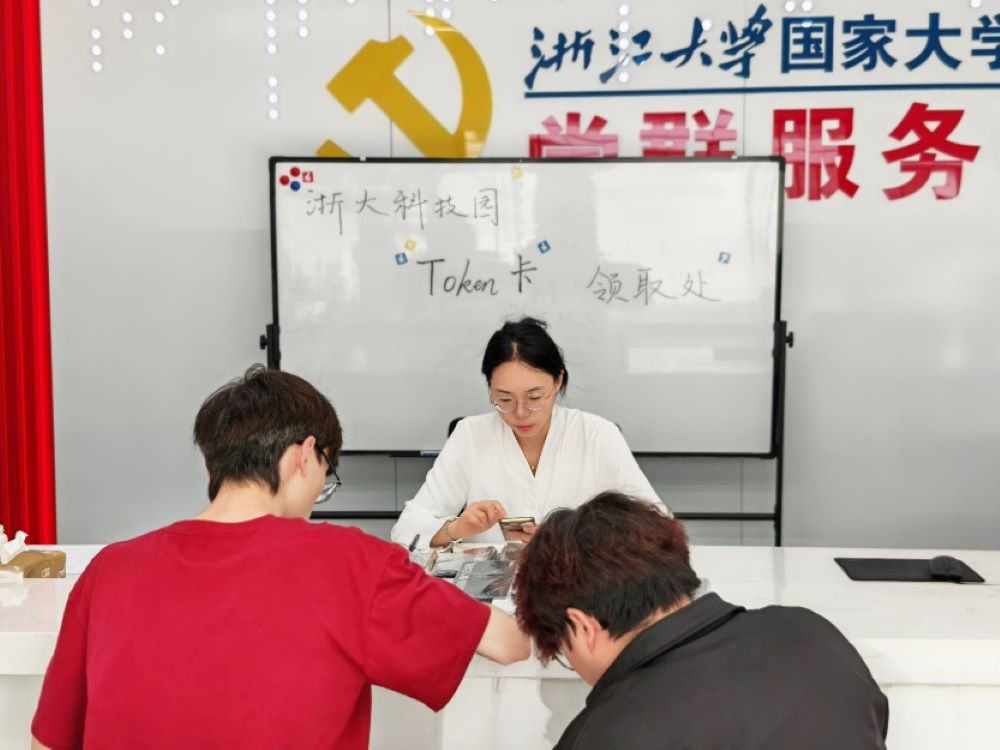
Entrepreneurs have already begun using the credits for tasks ranging from data analysis to research and consulting.
Mo Zhuorui (莫卓锐), a startup founder at Zhejiang University Science Park, said the 500 yuan in credits could cover a wide range of tasks, including data analysis and research tools available through QwenWork’s Skill marketplace.
Zhang Peng (张鹏), a master’s student at Zhejiang University, said AI already generates 80% to 90% of the code used by his team. He plans to move its software from in-house servers to QwenWork to reduce infrastructure and maintenance costs.
A new model for talent support
The pilot reflects a broader shift in how local governments are supporting AI-driven entrepreneurship.
Instead of only subsidizing rent or providing cash, cities could increasingly help startups by covering part of their AI usage costs.
Alibaba’s QwenWork opened its international beta in August, while Alibaba Cloud also offers token-based subscription plans in markets including Singapore.
Separately, Alibaba has agreed to provide eligible faculty and students at the University of Science and Technology of China with free AI computing services through QwenWork and Qoder.
The September 19 deal is the first under Alibaba’s university AI charity program, with more schools expected to join.
Why it matters globally
For international observers, Hangzhou’s experiment offers an early example of how public services could adapt to AI-driven work: lowering the cost of accessing AI infrastructure rather than simply subsidizing the cost of office space.
Whether that model can meaningfully boost startup productivity remains to be seen, but the experiment suggests AI computing is beginning to emerge as a new input in local economic-development policy.
Header image generated by Doubao