- Robotics parts, optics, physical AI startups attracted fresh capital as investors backed technologies moving from components and models to real-world deployment.
- New funding rounds spanned humanoid robot supply chains, AI-powered laboratories, autonomous vehicles and edge intelligence platforms
Demark raises $62 million Series C to expand robotics parts manufacturing
Precision component maker Demark (德玛克精工) has completed a 420 million yuan ($62 million) Series C funding round led by Furong Capital, with participation from Changxing Industry Group, Nanhu Equity Fund, HuaYi Ventures, Vision Plus Capital, Deqing Industry Investment, Huaan Jiaye and Guoxin Venture Capital.
Existing investor Yunqi Partners also participated.

A national-level “little giant” company specializing in high-end equipment components, Huzhou-based Demark supplies precision parts for semiconductors, robotics and new energy industries.
It has become one of the world’s largest suppliers of key components for humanoid robots.
Its product portfolio includes robot joints, reducer housings and semiconductor equipment chambers. The company supplies several leading domestic robotics companies, with shipments doubling in the first half of 2026.
The latest funding will support advanced manufacturing technology development, capacity expansion and market growth in robotics and other sectors.
Vecverse raises pre-Series A round for AI-powered life science tools
Hangzhou-based physical AI life science company Vecverse (术也科技) has closed a pre-Series A round worth tens of millions of yuan led by Taipu Life Sciences Investment, with participation from Wanyuandian Capital.
Founded in 2018, the company focuses on applying vision-language-action (VLA) models to laboratory environments, turning traditional instruments such as pipettes and PCR machines into intelligent agents capable of perception, decision-making and collaboration.
Its AI voice-controlled smart pipette Pette weighs just 99 grams and has received multiple international design awards, while its Robot laboratory automation products have been deployed in more than 10 applications including PCR, ELISA and sequencing preparation.
The funding will support further development of AI-driven laboratory automation technologies.
Optical device startup Mumuxili raises tens of millions of yuan in Series B financing
Nanjing-based optical equipment developer Mumuxili (木木西里) has completed a Series B round valued at tens of millions of yuan led by Huarui Group, with investment from Zhongsheng Huipu, Giant Rock Fund and Jiangning Development Zone Fund.
Founded in 2014, the company develops high-end optical inspection instruments, combining equipment manufacturing, technology services and industry SaaS capabilities.
Its products cover optical microscopy imaging and industrial vision inspection systems. The new funding will support technology development, production expansion and regional service network construction.
Airobo snags first funding round for robot operations platform
Shanghai-based robot operation platform Airobo has completed its first funding round, raising hundreds of millions of yuan from a consortium of undisclosed industrial investors and venture capital firms.
This deal marks one of the largest initial financings in China’s robot operations sector.
Founded only six months ago, the company focuses on robot-as-a-service solutions for residential communities and property management scenarios.
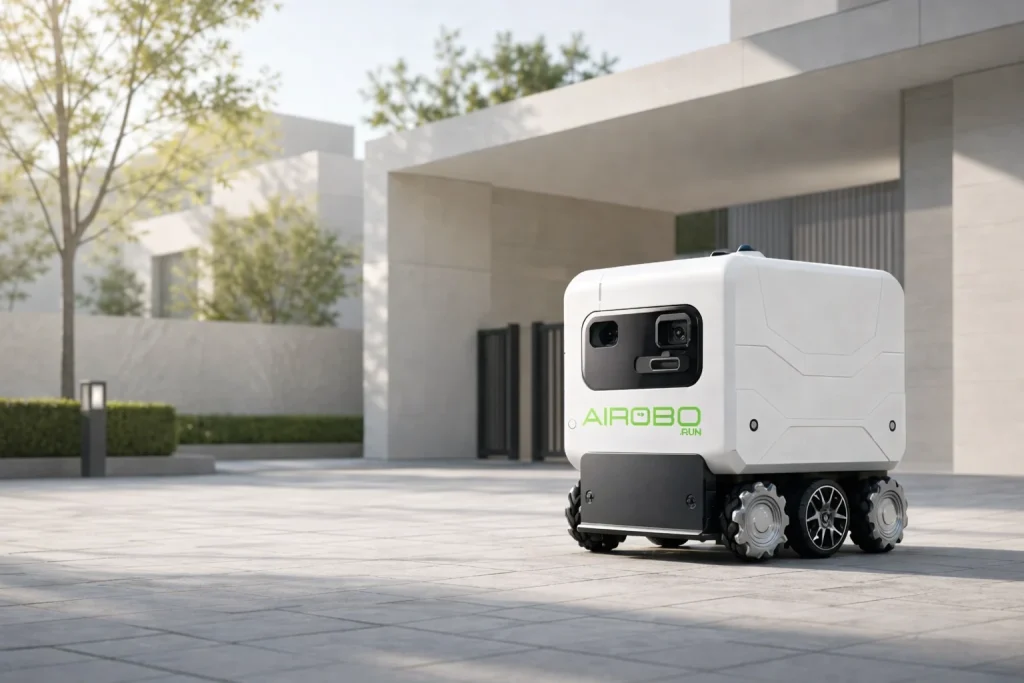
It has secured partnerships with major property service providers including Greentown and Longfor, with pilot projects underway in Beijing, Hangzhou and Chengdu.
The funding will be used to build city-level operations networks, expand community deployments and develop robot world model systems.
Guanrui Huitu raises seed round for autonomous driving solutions
Autonomous driving startup Guanrui Huitu (观瑞慧途) has completed a multi-million-yuan seed round led by M.xi.Fund.
Founded by a team from Tsinghua University, Beihang University and other research institutions, the company focuses on autonomous vehicles for industrial logistics, park inspections, airports and ports.
Based in Anhui Province’s industrial city Wuhu, it has developed a full-stack technology system covering vehicle-by-wire conversion, chassis control, perception, localization, decision-making and cloud-based scheduling.
The company’s products include autonomous towing vehicles and patrol vehicles, with the funding supporting technology upgrades and vehicle engineering development.
Om AI raises multi-billion-yuan round for edge physical AI
Hangzhou-based edge physical AI company Om AI (联汇科技) has completed a new financing round valued at hundreds of millions of yuan, led by Qianhai FoF, with participation from Hangzhou Government Industry Fund and other investors.
The company focuses on “edge-native” streaming multimodal AI models and has developed its VLX foundation model, designed to integrate continuous perception, precise localization and action decision-making.

Its open-source VLX-Seek 1.5 model achieved a 62.9% accuracy improvement over comparable NVIDIA models in drone embodied AI scenarios, while reducing target false positives by 74.8%.
Om AI has also partnered with Lenovo and Apple on AI PC hardware adaptation and developed Homer AI, a wearable AI vision device serving nearly 100,000 visually impaired users.
The company claims its platform handles tens of millions of AI calls each month.