- Local regulators outlines support mechanisms for solo ventures in 11-point framework
- City sets up new tools platform, training programs and industry-focused communities to connect and serve individual creators
Taizhou, a city in Zhejiang Province, is placing a policy bet on a new entrepreneurial archetype emerging in the artificial intelligence era: the AI-enabled individual founder.
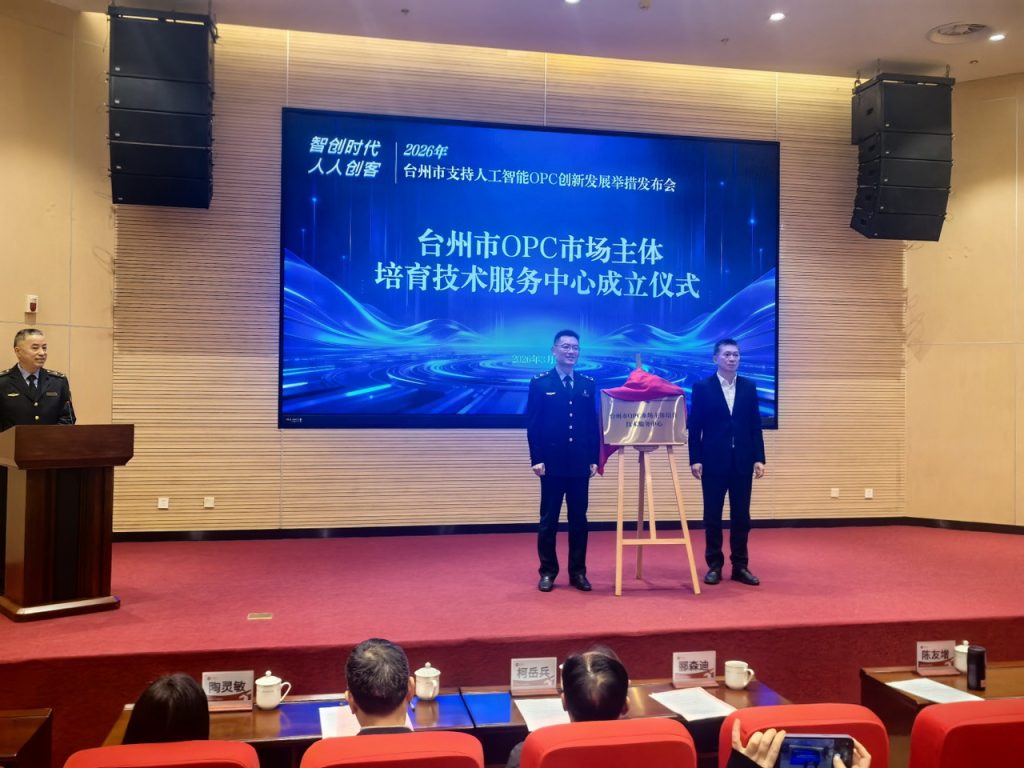
At a March 21 conference focused on OPC innovation and skills development, local authorities released an 11-point support framework designed specifically for artificial intelligence One Person Companies (OPCs).
OPCs — short for One Person Companies — describe a new generation of ventures in which individuals rely on AI systems to perform functions traditionally handled by teams, from product development and design to marketing, operations and customer service.
The initiative, introduced by the city’s market supervision bureau, is reportedly the first dedicated policy package for AI-assisted OPC development issued by a market regulator in Zhejiang province.
This underscores how local governments are beginning to adapt governance models to AI-driven business structures.
Taizhou is not alone is tapping this OPC mania. The Yangtzeer reported last week that Wenzhou, another Zhejiang city bordering Taizhou to its south, has rolled out a sweeping policy package intended to attract more than 20,000 “super-individual” entrepreneurs and incubate over 10,000 OPCs by 2028.
Rather than treating solo entrepreneurship as small-scale activity, Chinese policymakers increasingly view it as a scalable economic unit enabled by automation.
A ‘closed-loop ecosystem’
The Taizhou program attempts to build a full operating environment around that premise. Officials framed the initiative as a “closed-loop ecosystem” combining policy support, digital infrastructure, application scenarios and professional services.
Central to the rollout is a newly launched integrated OPC service platform developed by the municipal digital group.
The system aggregates government services with market-facing tools, allowing founders to access compliance assistance, operational resources and commercialization support through a single interface — an effort to lower startup costs while improving survival rates for early-stage ventures.
Institutional backing is expanding alongside digital infrastructure. A technical service center dedicated to cultivating OPC market entities was jointly established by the market supervision bureau and the city’s investment group.
This marked a move toward standardized incubation tailored specifically to AI-native businesses.
OPC communities
Meanwhile, Taizhou has introduced its first OPC communities, organized around film and creative industries as well as “AI plus manufacturing,” sectors seen as natural testing grounds for AI-assisted production models.
The event also included the city’s inaugural OPC entrepreneur training program, offering practical instruction in AI tool deployment and business model design — reflecting recognition that the main bottleneck for AI entrepreneurship may now be operational know-how rather than access to technology itself.
The announcement follows earlier OPC reporting on the rise of AI-powered solo ventures across China, where advances in generative AI are reshaping assumptions about company size and productivity.
Taizhou’s initiative suggests local governments are beginning to move beyond observation into early leadership, experimenting with regulatory frameworks and support tools.
Officials in Taizhou say the next phase will focus on expanding real-world application scenarios and improving resource matching between founders, industries and public services.
If the model gains traction, Taizhou’s experiment could signal a broader shift in how cities compete in the AI economy — by enabling networks of highly capable individuals rather than relying solely on large enterprises or traditional startup clusters.
This approach aligns with Zhejiang’s growth model, driven primarily by the initiative of the private sector rather than government policies or large-scale state-owned enterprises.