- The multi-agent system autonomously plans, tests and refines scientific research from a single research objective
- Its long-horizon reasoning capability could reshape how AI accelerates scientific discovery across disciplines
Researchers at Zhejiang University on July 15 unveiled Qiushi Engine, an AI-powered scientific discovery system capable of autonomously conducting long-horizon research.
This launch marks a step beyond today’s AI assistants that primarily help scientists with individual tasks such as literature reviews, coding and data analysis.
Unlike existing AI research tools, which mainly automate isolated parts of the scientific workflow, Qiushi Engine is designed to sustain thousand-step reasoning over extended periods.
Given only a research objective, it can decompose a scientific problem, formulate hypotheses, design experiments, test ideas, analyze results and iteratively refine its approach until it reaches an original conclusion.

The system takes its name from Zhejiang University‘s longstanding “Qiushi” (“seeking truth”) tradition, reflecting the scientific method of continually testing hypotheses against evidence and moving closer to fundamental truths.
A multi-agent architecture
Developed by a group of researchers at the university’s College of Information Science & Electronic Engineering, the system adopts a multi-agent architecture, with specialized AI agents responsible for different tasks.
Some plan research strategies, others develop methodologies, execute experiments, analyze results, or challenge assumptions and identify potential risks.
Together, they operate much like a human research team tackling a complex scientific problem.
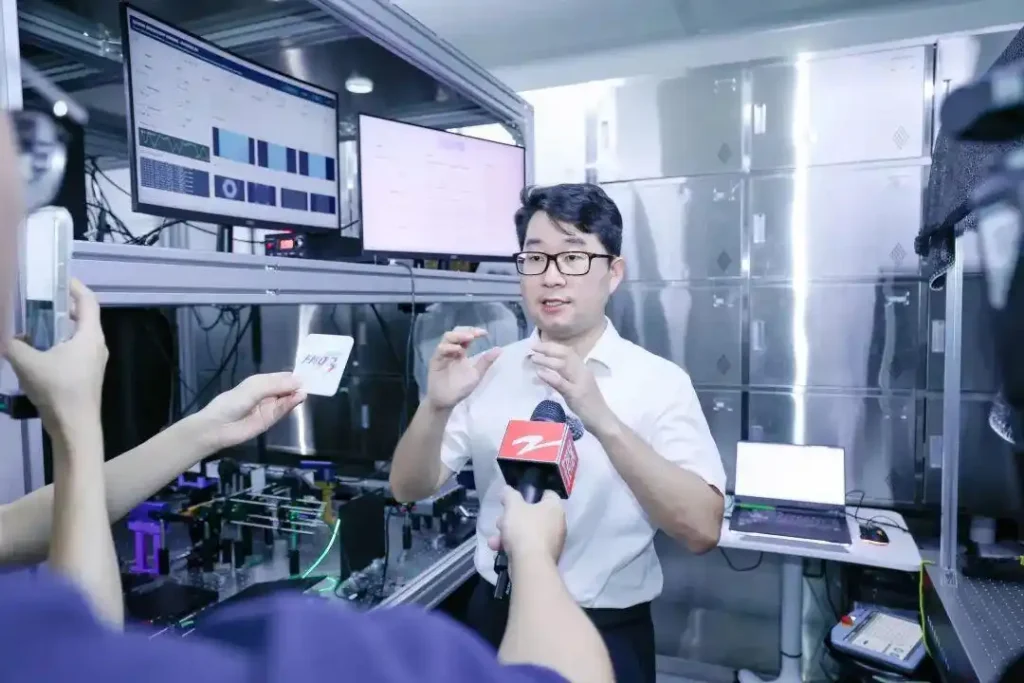
In validation experiments on a real-world optics platform, researchers provided the system with only an open-ended research objective. Qiushi Engine then worked autonomously for more than a dozen hours, completing literature reviews, theoretical analysis, experimental design, coding, data analysis and result evaluation.
After multiple rounds of failure, troubleshooting and verification, it independently produced several original scientific findings—work that would typically take human researchers weeks or even months.
The system has already been applied across more than 10 research fields, including physics, optics, biomedicine and mathematics.
In computational physics, it proposed a new theoretical approach to a decades-old fundamental problem. In spectroscopy, it established a new theoretical framework, while in optical computing it discovered a previously unknown computing mechanism.
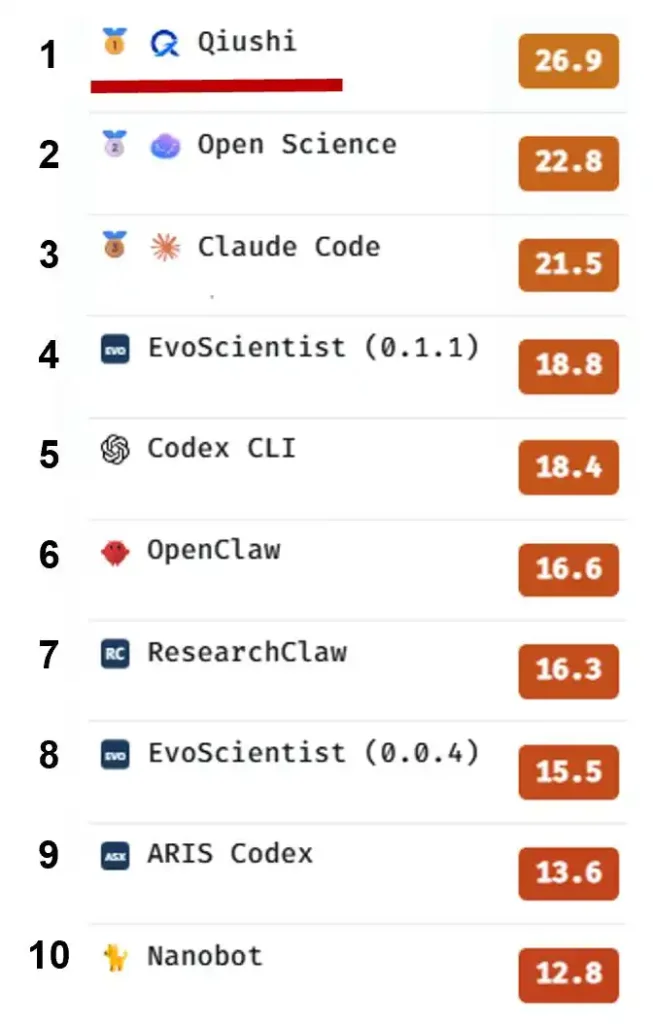
As of July 15, Qiushi Engine ranked first overall on international benchmark ResearchClawBench for multidisciplinary autonomous scientific research systems, the university claimed.
Pan Yunhe, a member of the Chinese Academy of Engineering, said global technological competition is shifting from building larger AI models to deploying them to solve complex real-world problems, with scientific research emerging as one of the most important applications.
AI-driven scientific discovery
The launch comes as autonomous AI research systems become an increasingly important frontier in global AI competition.
Last month, OpenAI introduced its “Loop Engineering” concept, which shares a similar vision of iterative AI-driven scientific discovery. Governments and research institutions worldwide are also making AI-accelerated scientific discovery a strategic priority.
As AI systems take on more long-horizon exploratory work, the economics of scientific research are beginning to shift.
Rather than spending weeks searching literature, designing experiments and debugging failures, human researchers can increasingly focus on defining important questions, evaluating research directions and interpreting discoveries, while AI handles much of the repetitive exploration, validation and preliminary analysis.
Why it matters for global readers
Qiushi Engine represents a shift from human-led research with AI assistance toward a model in which AI actively advances research while humans provide oversight and scientific judgment.
For the global scientific community, systems like Qiushi Engine could become research partners rather than replacements for scientists, taking over time-consuming exploratory work while allowing researchers to concentrate on asking better questions and evaluating scientific significance.
As AI becomes capable of autonomously completing the entire research cycle—from literature review to experimental validation—the pace of scientific discovery and the scope of interdisciplinary research could accelerate significantly, reshaping the global landscape of scientific innovation.