- Embodied AI enters traditional tea fields as spring harvest peaks
- Automation targets freshness bottleneck in mountainous plantations
Hangzhou-based robotics unicorn DEEP Robotics has deployed quadruped robot dogs in a West Lake tea plantation as the annual spring harvest began, showcasing how embodied intelligence can boost productivity by tackling practical bottlenecks in traditional agriculture.
The rollout aims to solve one of the most persistent logistical constraints for producing Longjing tea, a prized local specialty — moving freshly picked leaves down steep hills fast enough to preserve quality.


Carried out in the Longwu plantation, the trial comes during the crucial pre-Qingming harvest window, when West Lake Longjing producers race to process delicate leaves within roughly an hour of picking to lock in aroma and flavor.
But the tea’s core growing areas are scattered across narrow, winding mountain paths where human porters traditionally carry baskets by hand, slowing transport and increasing labor strain.
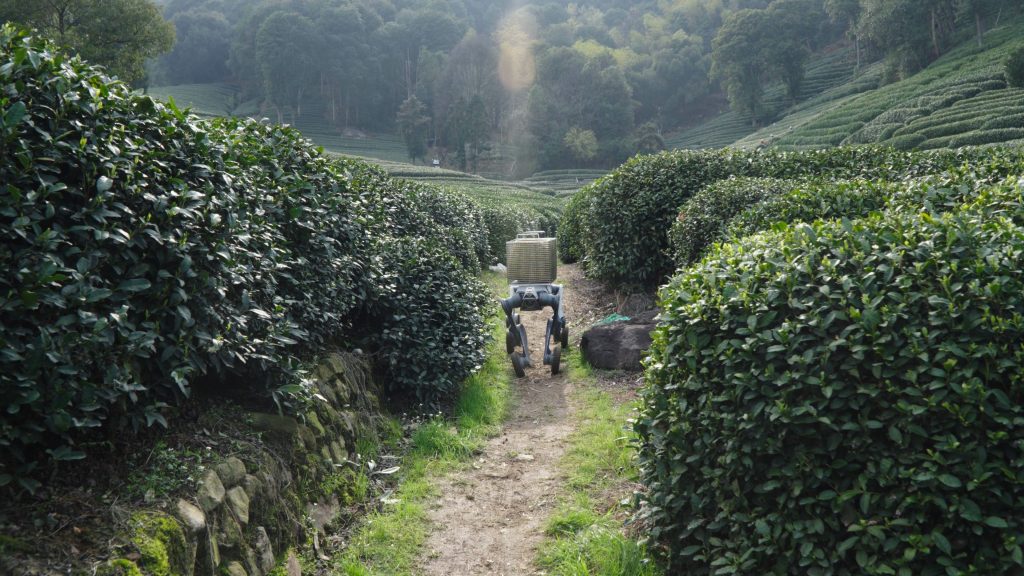
To address the bottleneck, DEEP Robotics partnered with JD Logistics to deploy its wheeled-legged robot M20 and industry-grade quadruped X30 to navigate pathways as narrow as 50 centimeters and climbing slopes of up to 45 degrees.
Completing the ‘first kilometer’
The machines shuttled baskets of fresh leaves directly from picking sites to processing workshops, creating what organizers described as a seamless link between harvesting and production.
The robots effectively completed the “first kilometer” of the tea supply chain, enabling freshly picked leaves to enter a same-day processing and shipping system — a key factor in preserving the premium quality that defines early-season Longjing tea.
The experiment highlights a growing push in eastern China to apply embodied AI to traditional agriculture, as labor shortages and rising efficiency demands accelerate the integration of robotics into heritage industries long defined by manual craftsmanship.