
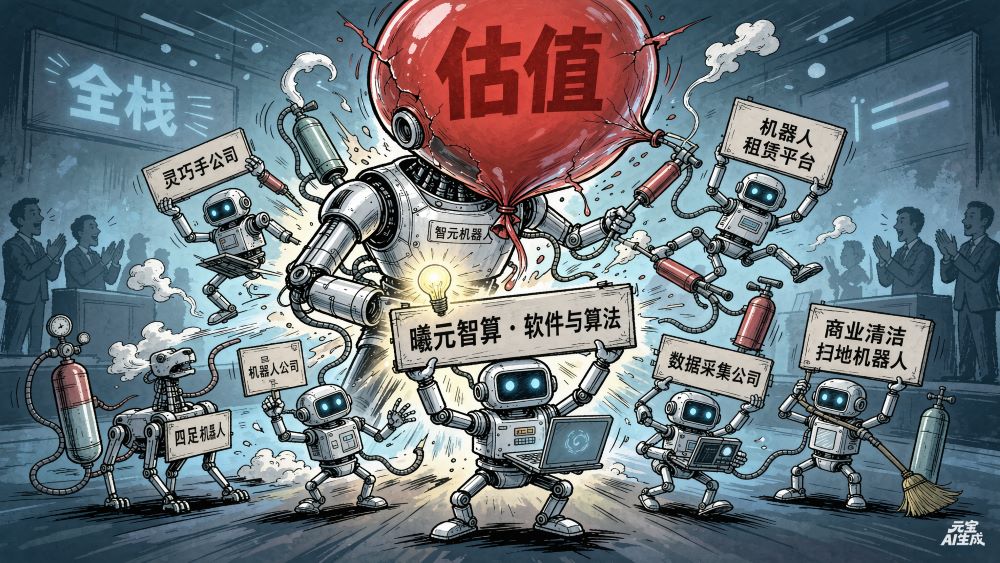
- The Shanghai company is expanding beyond robot hardware into AI infrastructure and foundational software ahead of a planned listing
- The move comes as AgiBot scales production at home and expands overseas, with international revenue nearing 20% in the first half of 2026
AgiBot (智元机器人), a leading embodied robotics developer, has set up a new AI computing company in Shanghai, adding foundational software and algorithms to an ecosystem that already spans humanoid robots, dexterous hands, data services and other robotics businesses.
XiYuan Computing (Shanghai) Technology Co., Ltd (曦元智算) was recently established as a wholly owned subsidiary of AgiBot Innovation (Shanghai) Technology, the listed entity associated with AgiBot, according to corporate registration data.
Its business scope includes AI algorithm software, foundational AI software, application software and general-purpose AI systems.
The new company adds another layer to AgiBot’s “1+5+N” ecosystem strategy.
Under the model, AgiBot Innovation focuses on embodied foundation models and humanoid-robot platforms, while five controlled subsidiaries target areas including dexterous hands, quadruped robots, data services, robot leasing and specialized commercial robots.
As part of the “N” component, AgiBot has also invested in more than 20 early-stage companies across the robotics supply chain.
Filling a gap
The new AI unit fills a gap in that structure by bringing more of the software and algorithm stack in-house.
AgiBot has previously said that R&D on the “brain and cerebellum” — meaning the embodied AI model and motion control algorithms — of its robots already accounts for about three-quarters of its R&D workforce and spending.
The timing is notable. AgiBot generated 1.05 billion yuan ($156 million) in revenue in 2025 and more than 1 billion yuan in the first quarter of 2026 alone. Its cumulative robot deliveries surpassed 15,000 units by June.
The company formally began preparations for a Hong Kong listing in July, targeting a valuation of roughly 34.6 billion to 43.3 billion yuan.
The timing is also hard to ignore. With AgiBot preparing for a Hong Kong listing, the creation of a separate AI software and computing arm gives investors another piece of the technology story — and potentially another basis for a higher valuation.
Less convincing rationale
But the rationale is less convincing from a business perspective. Humanoid robots, quadrupeds and robot data collection already depend heavily on AI models and algorithms, making it difficult to see why a separate company is necessary purely from a technology standpoint.
That raises a more obvious question: is the new unit as much about the IPO narrative as it is about technology?
Setting up a dedicated AI software company shortly before a listing could help AgiBot present itself as a full-stack AI robotics player rather than simply a robot manufacturer, adding another layer to the valuation story.
The move may therefore be strategic on both fronts — strengthening control over its technology stack while giving investors a broader vision of what AgiBot could become.
But whether that translates into a durable technology moat, rather than a bigger pre-IPO story, remains to be seen.
Header image generated by Yuanbao

