

- The spatial-intelligence company surged as much as 29% after becoming eligible for mainland trading through Hong Kong Stock Connect
- The move comes after a dramatic post-IPO rally and an 80% plunge, leaving investors to reassess its bet on AI beyond home-design software
Manycore Tech (群和科技) surged as much as 29% on September 7 after the Hong Kong-listed spatial-intelligence company was added to the Shanghai-Hong Kong Stock Connect program, opening its shares to eligible mainland investors.
The stock reached HK$12.63 intraday, its highest level in about six weeks, after mainland investors gained access to the shares through the southbound trading channel.
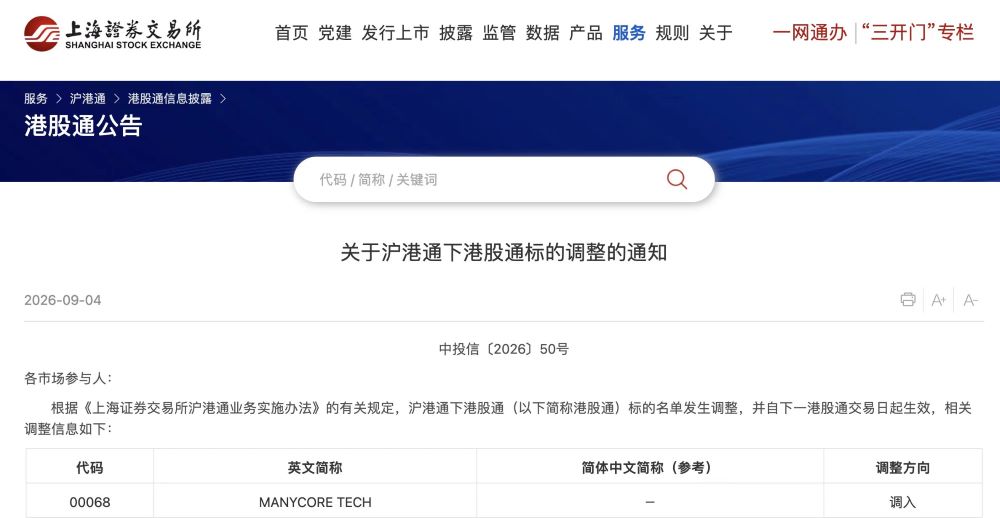
The Stock Connect inclusion gives Manycore access to a broader pool of Chinese investors and could improve trading liquidity.
As of this writing, its shares were trading at HK$12.09, giving the firm a market value of HK$20.87 billion.
Boom and bust
The move comes only months after a spectacular boom-and-bust cycle.
Manycore, dubbed the “first spatial-intelligence stock” and the first of Hangzhou’s so-called “Six Little Dragons” to go public, debuted on the Hong Kong Stock Exchange on April 17 at HK$7.62 a share.
It surged to a record HK$48.50 within three trading days, briefly giving the company a market cap of HK$83.7 billion.
The rally quickly reversed, however, with the shares falling more than 80% to HK$7.40 on July 30, below the IPO price.
The volatility reflected a mismatch between the company’s AI narrative and its existing business, analysts said.
AI bet under scrutiny
About 90% of revenue still comes from its home-design software platform, Kujiale, which is closely tied to the property market. Its newer spatial-intelligence business remains a small part of the overall business.
The company has nevertheless been expanding beyond interior design into embodied AI, industrial digital twins and other spatial-computing applications.
Kujiale has accumulated more than 500 million 3D spatial-design scenes, which Manycore uses to build its spatial foundation models.
The company describes the resulting ecosystem as a flywheel linking spatial-design tools, spatial data and AI models.
It has also begun working with leading Chinese humanoid-robot companies including AgiBot (智元机器人) and Galbot (银河通用).
The AI business is beginning to show up in its financial results. In the first half of 2026, revenue from AI-related new applications and products rose more than 177% from a year earlier, while adjusted net profit reached 55.42 million yuan ($8.26 million), up 211%.
Further potential
The Stock Connect inclusion could further bolster the company’s valuation as it puts its spatial-intelligence story under a wider pool of mainland capital after months of extreme speculation and a sharp correction.
For Manycore, the next test is whether its emerging AI businesses can grow quickly enough to justify the valuation attached to its spatial-intelligence ambitions — and eventually reduce its dependence on the property-linked home-design market.
Header image credit: Manycore Tech’s official website

