

- The Chinese memory maker says its LPDDR6 delivers 60% more bandwidth and 20% lower power consumption than LPDDR5X
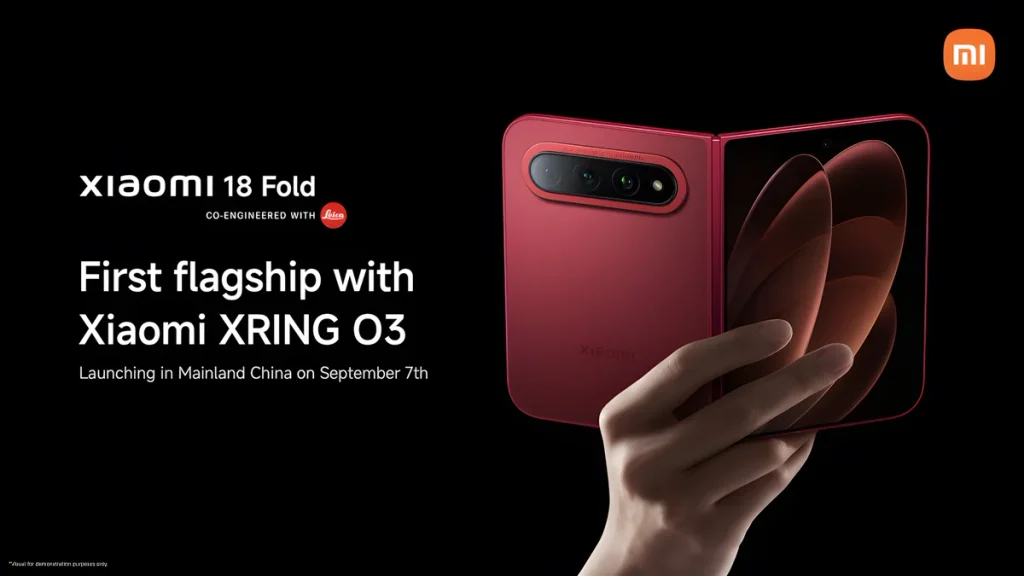
- The chips are debuting in Xiaomi’s 18 Fold, marking what CXMT calls the first commercial use of LPDDR6 in a flagship smartphone
Chinese memory maker CXMT (长鑫存储) has begun mass production and commercial deployment of its LPDDR6 memory, with the chips making their debut in Xiaomi’s 18 Fold flagship foldable phone.
Announced September 7, the launch marks what CXMT says is the first commercial deployment of LPDDR6 in a flagship smartphone worldwide, putting the Chinese memory maker on pace with the global industry in the latest generation of low-power mobile memory.

Far stronger specs
Each LPDDR6 chip has a 16Gb capacity, with a 16GB package capacity, and complies with the JEDEC LPDDR6 standard.
Hefei-based CXMT says it reaches transfer speeds of up to 12,800 Mbps, delivering 60% more bandwidth than LPDDR5X while cutting power consumption by 20%.
For smartphone users, the higher bandwidth can help devices process AI models and demanding applications faster, while lower power consumption can help extend battery life.
The memory uses several new technologies, including a dual-channel architecture for more efficient data transfer and dual-rail dynamic voltage and frequency scaling.
Competing head-to-head globally
This architecture adjusts performance and power consumption according to workload.
A high-thermal-conductivity packaging material also improves heat dissipation by about 40%, according to CXMT.
CXMT General Manager Zhao Lun (赵纶) said the company now has “the ability to compete head-to-head with leading international manufacturers.”
Closing the mobile-memory gap
The launch marks another step in China’s push into a DRAM market long dominated by Samsung Electronics, SK Hynix and Micron Technology.
CXMT ranked fourth globally with a 7.67% share of the DRAM market in the fourth quarter of 2025, according to market research data.
Its previous-generation LPDDR5X was about two years behind leading global products, while LPDDR6 has arrived almost in sync with the international market, according to the company.
Growing role in edge AI
The timing is significant as smartphones increasingly run AI models locally.
Higher memory bandwidth is becoming an important constraint for on-device AI, alongside processing power, as applications demand faster movement of increasingly large amounts of data.
CXMT’s LPDDR6 rollout shows that Chinese memory makers are moving beyond chip development toward commercial-scale production and deployment in high-end devices.
The company expects the technology eventually to expand beyond flagship smartphones into smart vehicles, edge servers and wearables.
For China’s AI hardware industry, the bigger significance is supply-chain depth. As domestic memory production scales, Chinese device makers could gain a more diversified source of high-end, low-power memory for increasingly AI-heavy products.
Header image credit: ChangXin Memory Technologies

