
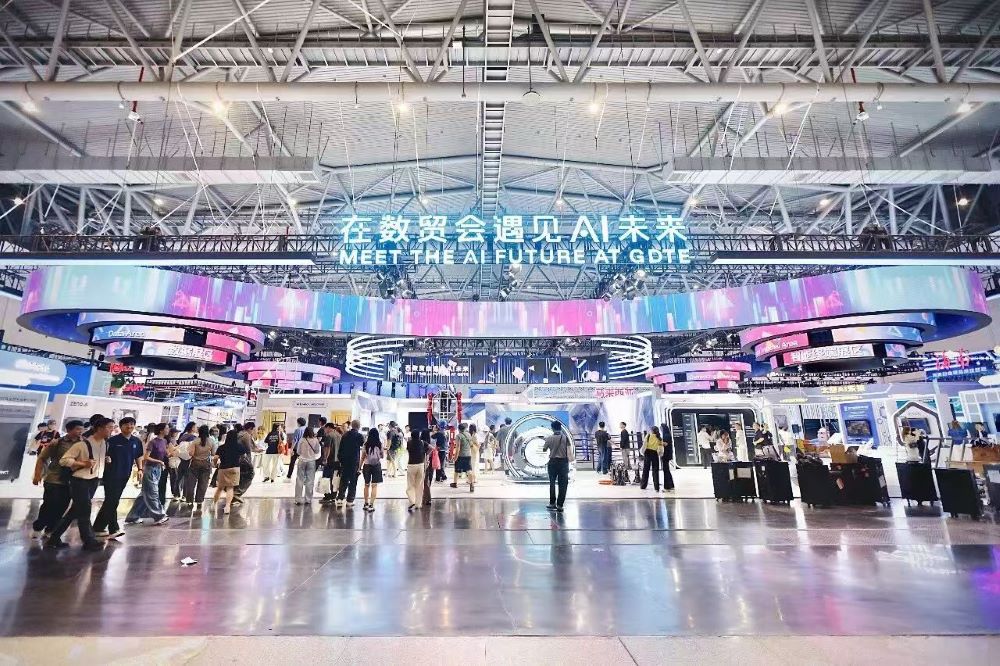
- AI-related orders account for more than half of $940 million in deals sought by international buyers
- Robots, AI chips and autonomous vehicles showcase Hangzhou’s push into the full AI supply chain
AI has moved from a technology showcased at China’s digital trade expo to one of the main products being bought and sold, with AI-related orders accounting for more than half of the international procurement deals sought at this year’s event.
The 5th Global Digital Trade Expo opened in Hangzhou on September 23 with more than 2,000 companies from 50 countries and regions, including 402 international exhibitors.
The five-day event covers 170,000 square meters, with AI-related companies accounting for roughly half of exhibitors.
International buyers have placed more than $940 million in preliminary procurement orders, up 47% from last year, with AI-related products and services accounting for 53% of the total, according to the conference organizer.
Orders involving AI applications, data centers and AI-powered devices each grew by more than 50%. Singapore and South Korea are among the countries making procurement requests at the expo for the first time.
Hangzhou’s AI stack takes shape
The shift is reflected on the expo floor, where more than 200 large AI models are being showcased alongside computing infrastructure and applications.
A dedicated token section also covers the AI supply chain from computing power and model services to end-user applications.
Hangzhou’s leading AI companies are using the expo to showcase technologies ranging from robots and chips to augmented-reality glasses and space computing.
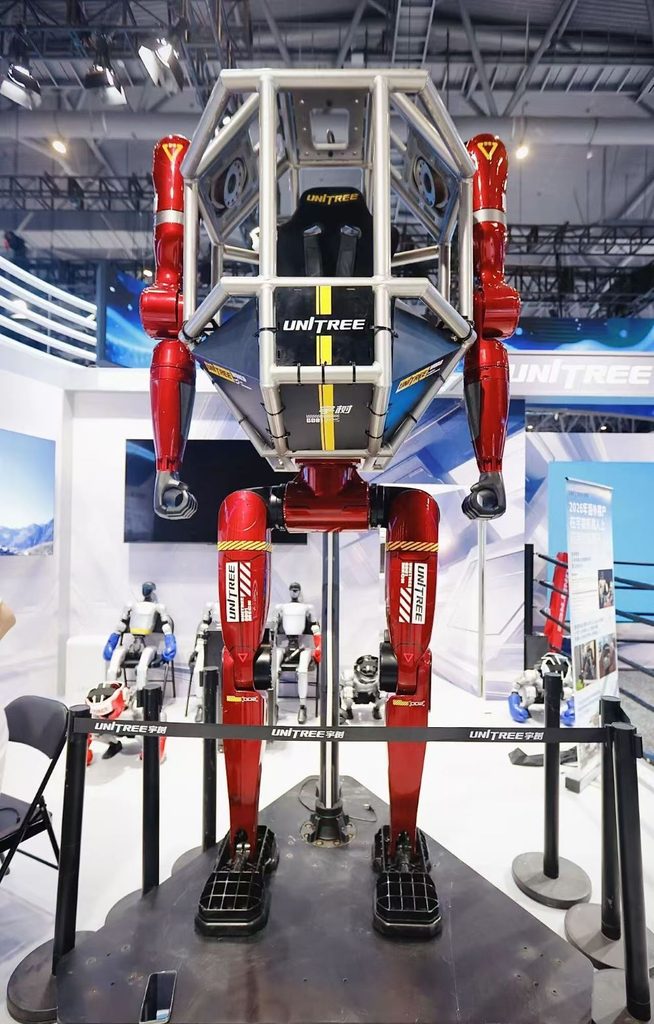
Robotics and embodied intelligence continue to attract the most attention. Unitree is displaying the GD01, a roughly 3-meter-tall transforming vehicle that it calls the world’s first mass-produced manned mecha.
Robots showcase their skills
Xynova (曦诺未来), a Hangzhou-based firm making robotic hands, is showcasing the Flex 2 dexterous hand, which it describes as the world’s first hybrid-drive dexterous hand.
Flex 2 has 23 degrees of freedom and near-real-time replication of human hand movements through teleoperation, Xynova said.

Geng Hongwang (耿红旺), an engineer at Xynova, added that the dexterous hand’s lead screws, coreless motors, miniature electric cylinders and motion-control algorithms are all developed and manufactured in-house.
“This is the company’s core competitive barrier,” he said.
Another Hangzhou-based embodied robotics developer Zeno AI (芝诺机器人) is demonstrating a different kind of robotics: two robots independently negotiate how to put a duvet cover on a bed without pre-programmed scripts or a central controller.
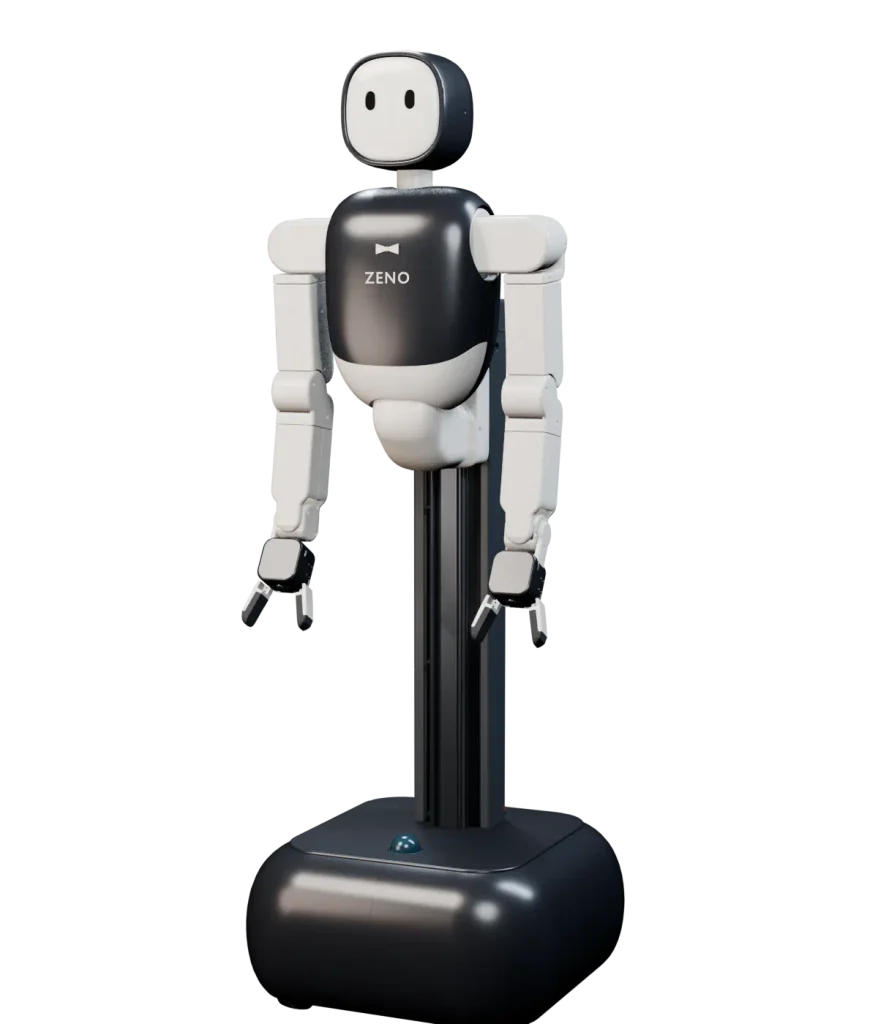
The long-horizon task is designed to show how robots can coordinate rather than simply execute fixed commands.
Wu Yuhan (吴宇涵), an executive at Zeno AI, said robot-to-robot collaboration will be “a very important direction in the future.”
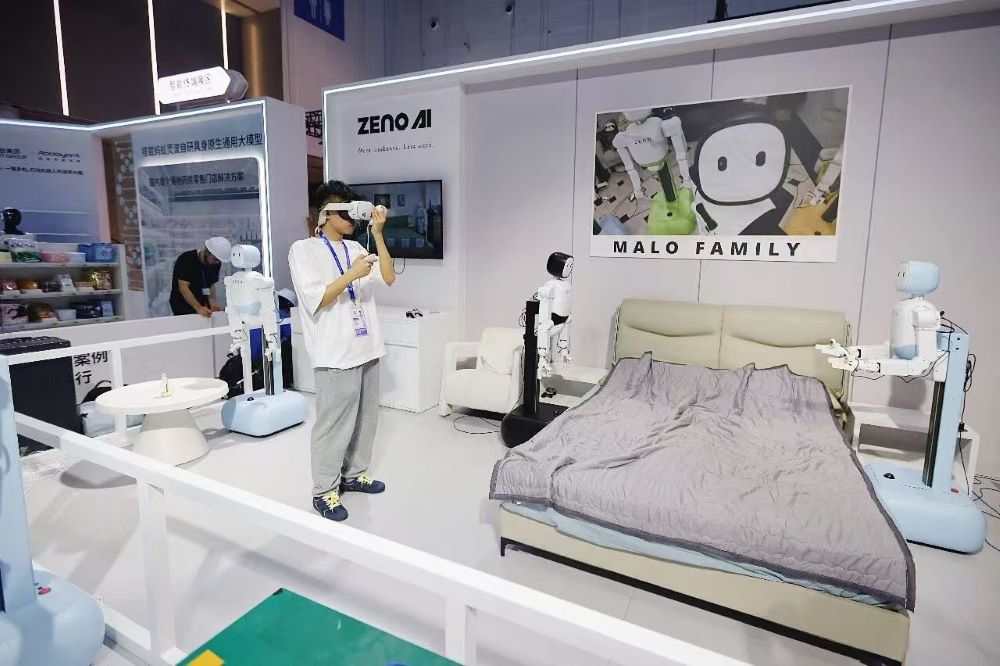
For example, folding a quilt is difficult for a single robot because it cannot shake the quilt open, whereas two robots can independently assess each other’s position and divide up the task, he explained.

Together, the exhibits highlight Hangzhou’s attempt to build an AI ecosystem extending beyond applications into chips, computing infrastructure, robotics and other underlying technologies.
Future mobility takes the floor
Low-altitude aircraft and autonomous vehicles are another major draw at the expo.
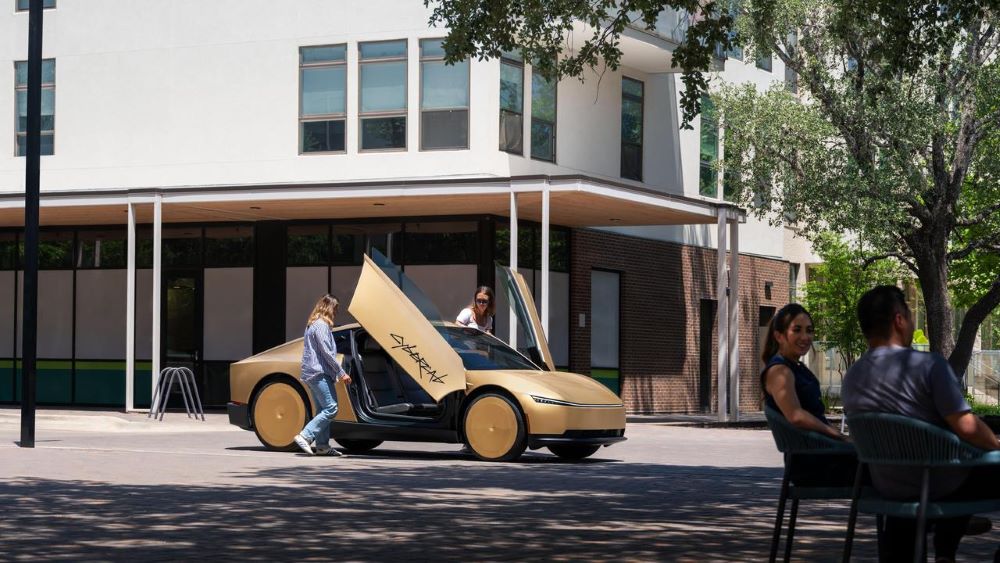
Tesla’s Cybercab, its steering-wheel-free robotaxi vehicle, has made its first public appearance in Zhejiang at the conference.

Meanwhile, EVT Aerotechnics (亿维特), an eVTOL maker that recently moved its headquarters from Nanjing to Hangzhou, is displaying a full-scale ET9 aircraft, while rival BlueVector (蓝色向量) is showing its Skyla V30 all-electric tilt-rotor eVTOL.
The concentration of autonomous vehicles, flying vehicles and embodied AI at the same event reflects a broader convergence in China’s emerging technology economy.
AI is increasingly moving out of software and into machines that drive, fly, work and interact with the physical world.
Header image credit: Global Digital Trade Expo official WeChat

.jpg)