

- Hangzhou is using state-backed capital, test sites and real-world demand to build an eVTOL industry from the ground up
- A growing number of aircraft makers are moving headquarters to the city as competition for China’s low-altitude economy heats up
Hangzhou is making an increasingly aggressive push for China’s emerging eVTOL industry — and it is using more than subsidies to bring aircraft makers in.
The latest arrival is Dreamfly (追梦空天), a leading Chinese hybrid tilt-rotor eVTOL maker that has established its headquarters in Hangzhou’s Xiaoshan District.
In early September, Hangzhou Low-Altitude Industry Development Co. led a Series A+ funding round worth hundreds of millions of yuan in the company.
“Xiaoshan has a well-developed industrial ecosystem, abundant application scenarios and efficient government services,” Dreamfly founder and CEO Cai Wenkuan (蔡文宽) said when the company signed the agreement to move its headquarters there.
The pitch is becoming familiar.
In June 2025, Geely Technology Group’s Aerofugia (沃飞长空) established its East China headquarters in Xiaoshan, becoming the first crewed eVTOL manufacturer to set up its headquarters in Hangzhou.
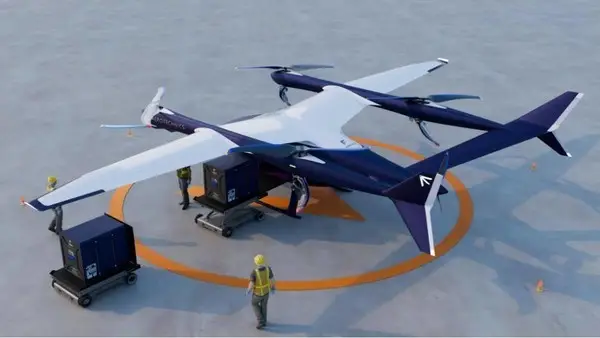
A year later, Dreamfly followed. Next month, EVT Aerotechnics (亿维特航空), a compound-wing eVTOL maker whose founding team comes from Commercial Aircraft Corporation of China (COMAC) and has experience with the C919’s airworthiness certification, plans to relocate its headquarters from Nanjing to Hangzhou’s Shangcheng District.
Other parts of the emerging industry are moving in too.
Zhuoyi Intelligence (卓翼智能), a drone startup incubated by Beihang University, received a 200-million-yuan ($29.8 million) exclusive investment from Hangzhou Low-Altitude Industry Development Co. in December 2025.
“Hangzhou has a well-developed industrial ecosystem and strong policy support,” Zhuoyi’s founder and chairman Ren Xuefeng (任雪峰) said. “By putting our production base here, we want to build a complete chain from R&D through to commercial applications.”
It has since designated Hangzhou as its core strategic base in eastern China and plans to build a digitally enabled flexible manufacturing plant.

Skydragon Aerotech (蜻蜓翼行), a Hangzhou startup founded in 2024 by Beihang professor Tao Guoquan (陶国权), is developing a tilt-rotor eVTOL platform.
Drawing on Tao’s 16 years of experience in the technology, the company completed its prototype, ground testing and maiden flight within 15 months of its founding.
Hangzhou is hardly alone in chasing the low-altitude economy. Shanghai has its “five eVTOL dragons,” — a cohort of startups — while Shenzhen, Chengdu and Hefei are also building their own clusters.
What distinguishes Hangzhou is the way it is approaching the competition. Rather than simply recruiting individual companies — or poaching them from other cities or provinces — it is trying to assemble the ecosystem around them to increase its appeal.
Putting capital to work
Hangzhou Low-Altitude Industry Development Co. is at the center of that strategy.
The state-backed investment company led Dreamfly’s latest funding round, made an exclusive investment in Zhuoyi Intelligence and strategically invested in Aerofugia.
In these cases, capital has gone hand in hand with a commitment to establish operations in Hangzhou.
The city’s transport authorities say Hangzhou has also established a 3 billion yuan low-altitude industry fund.
The fund has bet on local companies including drone player Antwork (讯蚁科技), avionics equipment producer Longxing (龙兴航电) and flying robot startup Zero-Zero Robotics (零零科技), while helping attract the headquarters of Aerofugia, Zhuoyi Intelligence, and EVT Aerotechnics.

The objective is broader than bringing in a few high-profile names. Local authorities say the investments are intended to fill gaps in the industrial chain, particularly in eVTOL manufacturing and large-payload unmanned aircraft for emergency response and firefighting.
Giving aircraft somewhere to fly
Money can get a company to move. Infrastructure gives it a reason to stay.
Hangzhou’s Yuhang District is home to the Nanhu Civil Drone Test and Operations Base, the first specialized low-altitude flight-testing base in Zhejiang to receive approval from the Civil Aviation Administration of China.
The facility covers 15.7 square kilometers of airspace, with a maximum flight altitude of 300 meters, a 500-meter fixed-wing runway and an eVTOL takeoff and landing site.
Another 100 square kilometers of dedicated test airspace is available at the East China Intelligent Unmanned Systems Testing, Certification and Validation Base in Jiande, a county-level governed by Hangzhou.
For eVTOL developers, that creates a relatively complete local pathway from development and flight testing toward airworthiness certification, without having to build their testing infrastructure elsewhere.
Building demand from the ground up
Hangzhou has also spent years creating places for low-altitude aircraft to operate.
In October 2019, Hangzhou-based Antwork obtained what it described as the world’s first urban drone logistics license. A year later, Hangzhou was selected as one of China’s first civil unmanned-aircraft pilot zones.
By 2025, the city had 249 low-altitude governance routes, 175 low-altitude logistics routes and five helicopter passenger routes. Total low-altitude flight time reached 229,000 hours, up 35.5% from a year earlier, according to Hangzhou Municipal Transport Bureau.
Dreamfly’s planned headquarters complex includes a three-dimensional transportation hub with takeoff and landing facilities.

Zhuoyi Intelligence is targeting high-rise firefighting and forest and grassland protection — applications where local authorities can potentially provide both access and demand.
That matters because the biggest challenge facing eVTOL companies is no longer simply proving that an aircraft can fly. It is finding repeatable commercial uses that can justify the cost of developing, certifying and operating it.
Building an industry, not just a cluster
Hangzhou has been steadily expanding its policy support since 2024, when it unveiled a plan to become a leader in the low-altitude economy.
The city now has 429 companies across the low-altitude industry chain, with the sector valued at 43.6 billion yuan, up 32.4% year on year, according to local government data.
Dreamfly adds a major eVTOL manufacturing presence, while EVT gives Hangzhou a foothold in compound-wing aircraft technology.
“Hangzhou offers more than capital. It also gives us access to flight-testing airspace and airworthiness-certification resources. For us, that is more valuable than anything else,” an EVT spokesperson was quoted as saying in Chinese media reports in August.
As the industry grows, such companies could also pull suppliers of advanced manufacturing equipment, new materials, avionics and other components into the city.
This is the logic behind Hangzhou’s strategy: use state-backed capital to bring so-called “anchor companies” (链主) in, test infrastructure to help them develop, and find real-world applications to create a path to commercialization.

The real test is profitability
The eVTOL industry remains on the eve of commercial takeoff. Airworthiness certification, cost control, operational reliability and viable business models all remain work in progress.
The competition between cities, however, has already begun.
Hangzhou is betting that a thriving low-altitude economy can be built through more than subsidies. Its formula combines capital, airspace, infrastructure, government-backed applications and an expanding supply chain.
Cai called Xiaoshan the “best choice” for Dreamfly. But the real test will come when these companies pivot from being able to fly to being able to make money.
That is when Hangzhou will find out whether it can remain their best choice.
Header image credit: EVT Aerotechnics

