- A new industry forum in Songjiang brought satellite makers, chip designers, AI companies and investors together as China moves space computing from concept toward engineering validation
- The district is positioning itself as a hub for an emerging industry that could put AI computing directly into orbit
Shanghai’s Songjiang District is positioning itself at the center of China’s emerging space-computing industry, as satellite manufacturers, chipmakers, AI companies and investors increasingly converge around the idea of putting computing infrastructure in orbit.
The first national Space Computing Industry Development Forum, held in Songjiang on August 30, brought together parts of the supply chain that have traditionally operated in separate industries, from aerospace and semiconductors to cloud computing and AI.
The timing reflects a broader shift. A series of developments this summer have pushed space computing toward engineering and commercial validation.

Accelerating deployments
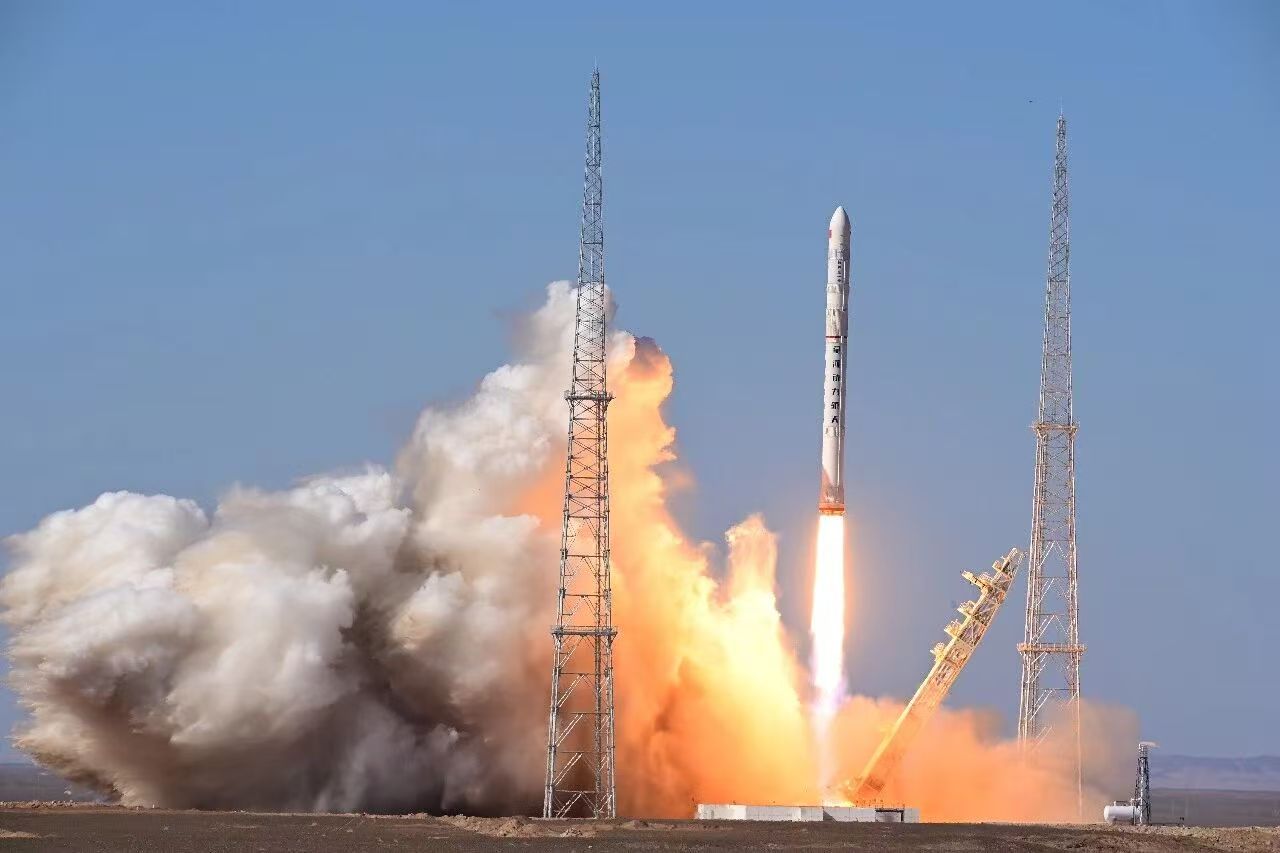
On July 24, Chen Guang-1 (辰光一号), an in-orbit computing power test satellite carrying key space-data-center technologies, was successfully launched from the Dongfeng Commercial Space Innovation Test Zone in Ejina Banner, Alxa League, Inner Mongolia Autonomous Region.
The first constellation of Xingshu Project (星枢计划) was officially unveiled on July 18, at the 2026 World Artificial Intelligence Conference (WAIC) in Shanghai.
The initiative, launched at Fudan University on May 16, is part of the nation’s broader strategy to develop its digital and computing infrastructure in outer space.
Putting computers in orbit
“Simply put, it means throwing a computer into space and using it to solve the problems we want to calculate,” said Liu Yaoqi (刘垚圻), chairman and CEO of Beijing-based ComoSpace (中科天算), a space-based intelligent application solutions provider.
Traditional satellites largely collect data and transmit it back to Earth for processing.
Space computing seeks to move more of that processing into orbit, allowing satellites to perform AI inference, image processing and potentially model training before transmitting only the results to the ground.
Wang Long (王龙), general manager of aerospace-focused media outlet Nihao Space (你好太空), said the industry has entered a new phase in 2026, moving from conceptual discussions toward engineering verification and industrial deployment.

Why Songjiang
Songjiang has made satellite internet a priority sector and has built an ecosystem spanning satellite manufacturing, constellation operations, payloads, components and applications.
The district’s national-level specialized cluster for satellite internet has more than 100 upstream and downstream companies, while the sector’s industrial output generated by firms with annual main-business revenue of 20 million yuan ($2.97 million) and above reached 23 billion yuan in 2025.
Spacesail (垣信卫星), a state-run operator of China’s Qianfan satellite internet constellation (千帆星座), and Genesat (格思航天), a satellite manufacturer, serve as major industrial anchors as the constellation accelerates deployment.
Qianfan Constellation, also known as the Spacesail Constellation or G60 Starlink, is China’s large-scale satellite internet constellation being developed to provide global broadband and multimedia connectivity.
Space computing is also emerging as a new growth area, with ComoSpace establishing its headquarters in the district and Shanghai Xingshu Tiansuan Space Technology Co. Ltd leading the Xingshu initiative.
A space-computing industrial base was officially launched at the forum. Under Songjiang’s action plan, the sector’s associated industries are expected to exceed 5 billion yuan by 2030, with more than 80 companies across the supply chain.
A new space-computing race
Space-based computing is emerging as a new frontier in the global competition for orbital infrastructure.
In January, SpaceX applied to the FCC to deploy as many as one million AI computing satellites.
China sees itself as having a relatively complete industrial foundation spanning satellite manufacturing, launch services, satellite internet, onboard computing and AI applications.
ComoSpace’s Liu said China is already in the global first tier in terms of engineering validation, supply-chain completeness and application development.
The significance of the Songjiang forum lies less in any single new technology than in the convergence of the pieces needed to build an industry.
As satellite platforms, computing hardware, thermal management, power systems and AI applications begin to develop around a common ecosystem, China’s space-computing supply chain is starting to look less like a collection of isolated technologies and more like an emerging industry.
Header image credit: Greg Rakozy/Unsplash