- The startup has drawn backing from Alibaba, Tencent, JD.com and Meituan as dexterous manipulation emerges as a key bottleneck for embodied AI
- Its robots are being tested in live commercial settings, reflecting a shift from lab demos toward sustained real-world performance
AI robotics startup Sharpa has raised more than 4.5 billion yuan ($670 million) in a first publicly disclosed financing round backed by some of China’s biggest technology companies, putting fresh capital behind the race to develop robots capable of dexterous manipulation.
The funding round, announced on August 28, values the Shanghai-based startup at reportedly 22 billion yuan post-money, roping in Alibaba, Meituan, Tencent, JD.com and Transsion, alongside venture firms including HongShan, Qiming Venture Partners, Meituan DragonBall Capital and Luminous Ventures.
Founded in late 2024 by Hesai Technology CEO David Li Yifan (李一帆), CTO Xiang Shaoqing (向少卿) and chief scientist Sun Kai (孙恺), Sharpa represents a second startup venture for the three founders of the LiDar maker.
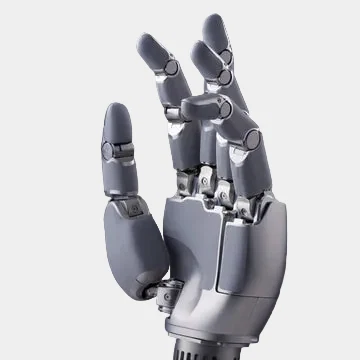
Its first product, the Sharpa Wave tactile dexterous hand, has 22 active degrees of freedom and entered mass production in October 2025.
Beyond Wave, the company now has two main product lines: North, a wheeled whole-body humanoid robot, and CraftNet, an AI model designed for dexterous manipulation.
Rather than relying primarily on laboratory demonstrations, Sharpa has been testing its technology in an operating restaurant.
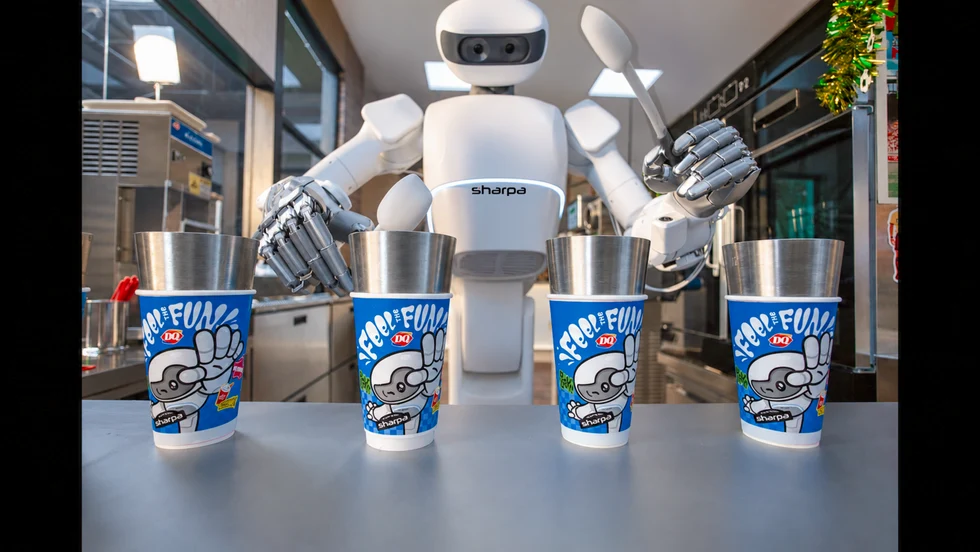
A new coworker at DQ
A fully autonomous robot deployed at a DQ store in Beijing can prepare a Blizzard ice cream through 55 steps without requiring modifications to the store.

Founder Li has described the minimum threshold for commercialization as the point at which a system is reliable enough for a customer to keep using it rather than merely succeeding in a one-off demonstration.
Sharpa first attracted international attention in May at GTC Taipei, when Nvidia CEO Jensen Huang unveiled the NVIDIA Isaac GR00T reference humanoid robot.
Unitree supplied the robot platform, while Sharpa provided its dexterous hands.
Fast-expanding industry
The company’s fundraising comes as China’s dexterous-hand market accelerates. Industry estimates put cumulative funding in the domestic sector at more than 8 billion yuan by the end of July 2026, up from about 500 million yuan a year earlier.

China sold about 19,200 dexterous hands in 2025, a 236.8% increase from the previous year. Sales are projected to reach 70,200 units in 2026 and potentially exceed 430,000 by 2030, according to GGII, an industry research firm.
LinkerBot (灵心巧手) remains one of the leading independent suppliers, with more than 80% of the global high-degree-of-freedom dexterous-hand market and a latest targeted valuation of $6 billion.
Other major players include Inspire Robots (因时机器人), BrainCo (强脑科技) and OYMotion (傲意科技). Robot makers such as AgiBot (智元机器人) and Unitree (宇树科技) are also developing their own dexterous-hand platforms.
Sharpa’s investor lineup points to a broader shift among China’s technology giants from backing foundation models toward the physical infrastructure needed to turn embodied AI into commercial products.
Changing economics
Dexterous manipulation is widely regarded as one of the key bottlenecks preventing general-purpose robots from reliably operating in complex real-world environments.


The economics are changing as well. Average prices for dexterous hands have fallen from about 50,000 yuan two years ago to below 10,000 yuan, according to industry data.
That decline could help move dexterous manipulation from an expensive laboratory component toward a mass-deployable robotics component.
For Sharpa, the larger test is not whether a robot can complete a task once, but whether it can do so reliably enough that customers keep paying for it.
The DQ deployment is only an early milestone; Sharpa will need to replicate the performance across a broader range of real-world tasks and customers to prove that its approach can scale commercially.
Header image source: Sharpa’s official website