
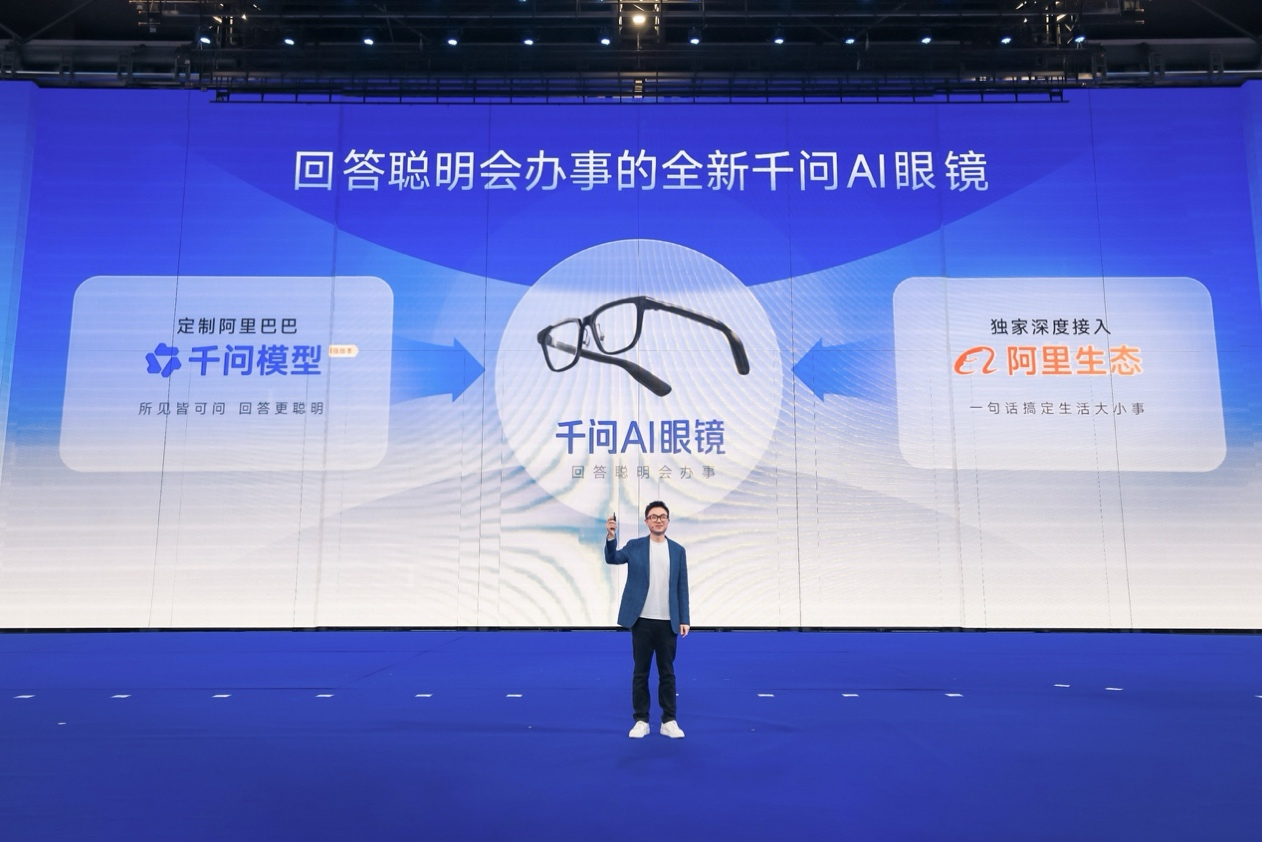
- New G1 smart glasses integrate Qwen large language model with voice-first services across Alibaba apps
- Device launches amid surging demand for smart eyewear in China’s rapidly expanding AI hardware market
Alibaba Group’s AI unit launched its Qwen AI Glasses G1 in China at the Appliance & Electronics World Expo 2026 (AWE 2026) in Shanghai on March 14, positioning the device as a voice-first wearable designed to bring its AI assistant into everyday consumer use.
The product’s domestic debut followed its global unveiling just days earlier at the Mobile World Congress 2026 in Barcelona, where Qwen, the generative AI affiliate of Alibaba, introduced the glasses as part of a broader effort to move AI services beyond smartphones and into dedicated hardware.
Equipped with Alibaba’s Qwen large language model, the glasses support features such as phone calls, photo and video capture, and real-time translation.
The company says the goal is to bring its AI assistant directly into a form factor users wear every day.
“We want to extend the Qwen AI assistant from a mobile app into a pair of glasses people wear throughout the day,” said Wu Jianjun, who leads AI hardware products for Alibaba’s Qwen consumer-facing business group. “When users need help, they can simply talk to AI anytime, making the glasses a personal intelligent assistant.”
Future updates will expand the device’s capabilities. Wu said the glasses will soon support AI-powered voice-clone translation, while additional features, including an “AI Task” function designed to handle everyday services, are scheduled to roll out by the end of March.
A key differentiator of the Qwen eyewear is the product’s deep integration with the broader Alibaba ecosystem.
Through voice commands alone, users can order food, check flights and hotels, compare prices, or look up store reviews by connecting directly with apps within the Alibaba ecosystem, such as Taobao, Alipay, Gaode Maps, Quark and Fliggy.
The experience is designed to work entirely through voice, without relying on a display interface.
The G1 weighs about 41 grams and features a dual-chip, dual-system architecture, 64GB of local storage, bone-conduction microphones, and enhanced low-light imaging powered by Super RAW technology.
Its right temple includes a hot-swappable battery system that allows users to replace the battery without powering down the device, enabling all-day use across different scenarios.
Priced at 2,899 yuan ($420), the glasses can drop to as low as 1,997 yuan ($290) after national trade-in subsidies and promotions by e-commerce platforms.
According to the company, the first batch sold out across all sales channels on the day of launch, and the product quickly topped smart glasses sales charts on platforms such as Tmall and Douyin.
Rapid expansion
Sources close to Qwen said the company’s next step is to open its ecosystem to third-party app builders. Besides, Qwen will launch an array of AI-enabled gadgets such as smart rings and earphones this year, with global sales to follow.
Industry data shows China’s AI glasses market is growing exponentially. Chinese research firm Runto Technology estimates that the country’s smart glasses sales jumped 211% year on year to 1.45 million units in 2025.
The sector is expected to exceed 3.2 million units in 2026, with new entrants including ByteDance, Samsung Electronics, Huawei and XGIMI intensifying competition, Runto says.
Meanwhile, global shipments by Chinese manufacturers are also rising. Research firm IDC projects that Chinese brands could account for about 45% of global smart glasses shipments by 2026.
According to data compiled by Qichacha, a business registry information provider, as of November 2025, among the 5,741 existing smart glasses-related enterprises in China, 36.11% were based in East China and another 32.75% operated from South China, forming the backbone of the industry.