- The machine-vision unit of Hikvision has had its Shenzhen listing review halted five times over expired financial disclosures since 2023
- But the deeper hurdle is whether the business can stand on its own after years of relying on its parent for procurement and other support
Hikrobot (海康机器人), the machine-vision and mobile-robotics subsidiary of Chinese surveillance equipment maker Hikvision, has had its planned ChiNext IPO suspended again, as repeated delays and lingering questions about its independence complicate a listing process that began nearly five years ago.
The Shenzhen Stock Exchange changed the review status of Hangzhou-based Hikrobot to “suspended” on September 30 because its financial information had expired and needed to be updated.
It was the fifth time since the exchange accepted the company’s application in March 2023 that its review had been halted for the same reason.
A five-year listing process
Hikvision first announced plans to spin off Hikrobot for a domestic listing in December 2021. The Shenzhen Stock Exchange formally accepted the ChiNext application on March 7, 2023, with CITIC Securities as sponsor and a planned fundraising target of 6 billion yuan ($895 million).
Since then, the review status has repeatedly switched between “suspended” and “under inquiry.”
The exchange suspended the review in June 2023, March 2024, September 2024 and March 2025 as financial disclosures expired, restoring the process after updated materials were submitted. The review was suspended again in March 2026, resumed in April and halted once more on September 30.
Hikrobot was among 71 companies whose IPO reviews were suspended by the exchange on September 30, including 56 ChiNext applicants.
The latest suspension is procedural and could be resolved by updating the financial disclosures. But the more consequential issue has been the regulator’s scrutiny of Hikrobot’s independence from Hikvision.
Independence under scrutiny
Before August 2020, Hikrobot had not established independent procurement and production systems. In that year, purchases from Hikvision and related parties accounted for 66.34% of its total procurement — more than six yuan out of every 10 spent.
The share had fallen to 10.88% in the first half of 2023. But the exchange’s concerns go beyond the latest percentage, focusing on whether related-party transactions are fairly priced and necessary, and whether Hikrobot can operate sustainably without relying on its parent.
The questions also touch on the source of its growth: how much comes from its own products and competitiveness, and how much from the distribution channels and business relationships it inherited from Hikvision.
Hikrobot’s revenue growth slowed from 25.9% in 2023 to about 20% in 2024 and 8.82% in 2025. As growth in the broader machine-vision market cools, the company faces greater scrutiny over whether its business can remain competitive independently of its parent.
A tougher climate for spin-offs
Hikrobot’s difficulties reflect a broader tightening of scrutiny over spin-offs in China.
The State Council’s new “Nine Measures” on capital markets, introduced in April 2024, called for stricter regulation of spin-off listings.
Other companies have also abandoned plans to list spun-off units. Display panel maker BOE (京东方) ended plans to list its energy-technology arm on the Beijing Stock Exchange amid questions over research and development independence.
Zhejiang Company (双环传动), a Zhejiang-based manufacturer of gears and precision transmisson components, withdrew plans in September 2026 to list its affiliate Fine Motion Technology (环动科技) on the STAR Market after nearly three years of preparation.
The planned Beijing listing by Tecon Pharma (天康制药), a pharmaceutical subsidiary of listed animal-health and agricultural company Tecon Biology (天康生物), was terminated after its sponsor withdrew.
Dubious ability to stand alone
These cases share a common question: whether a business carved out of a large corporate group has the operational, financial and technological independence to survive on its own.
Hikrobot’s application was accepted in March 2023, as scrutiny of spin-offs was becoming more demanding.
Regulators are looking beyond whether applicants meet quantitative listing thresholds including revenue and profitability to examine the substance of their independence.
Updating financial statements may restart the review, but it will not by itself settle the more fundamental questions about Hikrobot’s ability to stand alone.
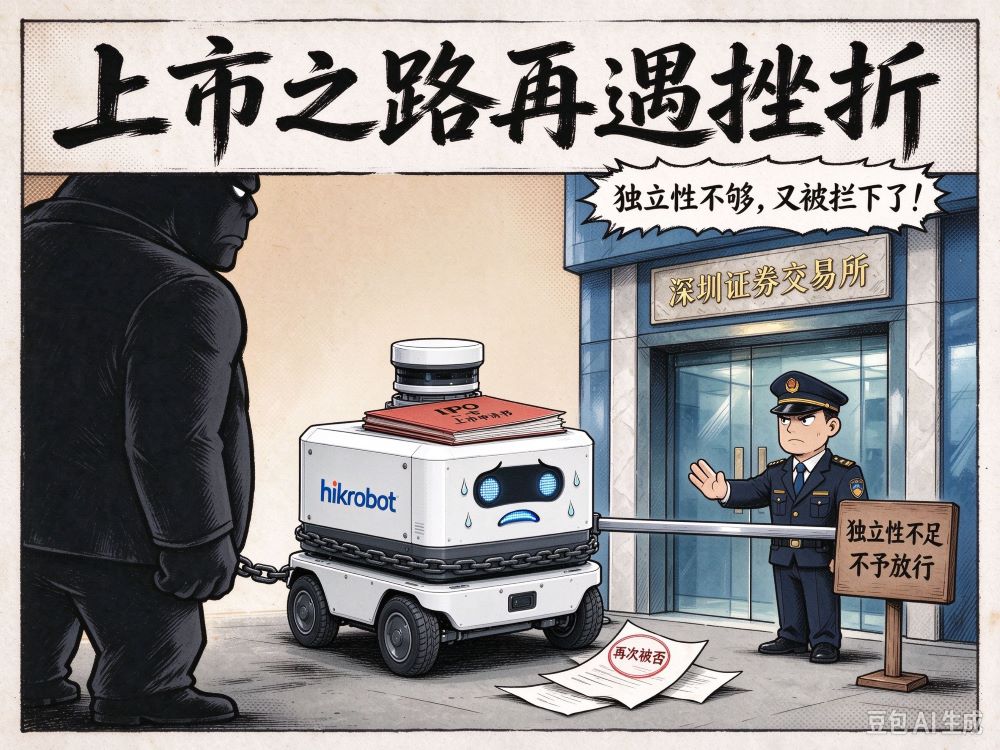
Header image generated by Doubao AI