
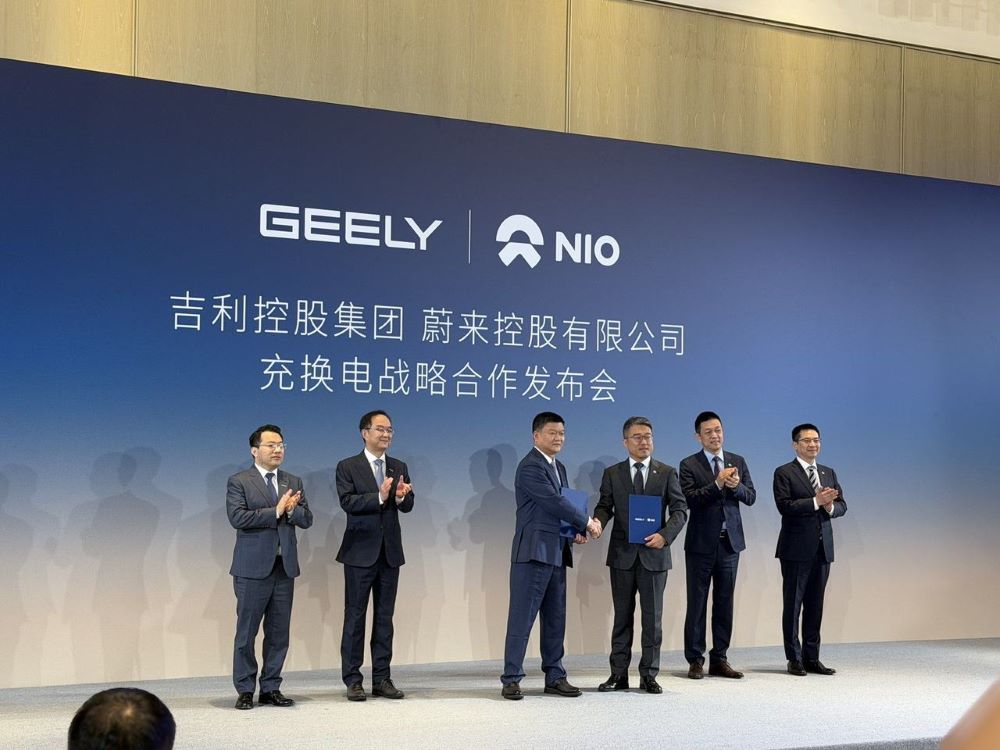
- Geely will take a 30% stake in Nio’s energy business by contributing assets and 640 million yuan in cash
- The two automakers plan to share charging and swapping networks and develop common standards for passenger vehicles
Chinese automakers Nio and Geely Holding are deepening their cooperation on battery swapping and charging through cross-shareholdings in their respective energy businesses, turning a partnership that began in 2023 into a closer commercial tie.
Under an agreement announced September 28, Geely will contribute its battery-swapping business and 640 million yuan ($95 million) in cash in exchange for a 30% stake in Nio Power, the EV maker’s battery swapping and charging business.
Nio will retain a 63.3% controlling stake, while the energy business will be valued at about 16 billion yuan after the deal.
Nio will also take a 10% stake in Haohan Power (浩瀚能源), Geely’s energy business, in a separate cash transaction. The two sides plan to connect their charging networks and share infrastructure.
The automakers will also develop common battery-swapping technologies and standards for passenger vehicles. Geely plans to develop battery-swapping models for consumers, while Nio will provide swapping services.
Nio founder and CEO William Li (李斌) said the deal is a response to China’s 15th Five-Year Plan (2026-2030) and an effort to improve the allocation of industry resources while curbing cut-throat competition.
Geely Holding CEO An Conghui (安聪慧) said charging and swapping networks should follow the principles of “sharing, connectivity, joint development and interoperability,” so that users can benefit from a more connected network.
From alliance to ownership
Nio and Geely began working together on battery swapping in November 2023, when Geely joined Nio’s battery-swapping alliance.
Several other automakers including Chery, JAC Motors, GAC Group and FAW later signed similar agreements, but the partnerships had largely remained at the agreement and technology level.
One obstacle has been the engineering work needed to adapt vehicles to a common swapping system. Automakers may need to redesign vehicle platforms and modify production lines.
Meanwhile, economics pose another major hurdle, as the battery-swapping market has yet to reach the scale needed to justify the investment.
As of September 26, 2026, Nio operated 4,125 battery-swapping stations in China, including 1,063 along highways, connecting more than 550 cities.
Battery swapping has long faced skepticism over its high costs and weak profitability. Nio’s station-construction costs have fallen from about 3 million yuan to 1.5 million yuan over the past few years.
However, more than 70% of early stations handled fewer than 40 swaps a day, below the 60 needed to break even, industry data show. Meanwhile, faster charging is narrowing swapping’s speed advantage.
Against this backdrop, the latest deal has bolstered market confidence in the battery-swapping partnership by putting real money and assets behind it.
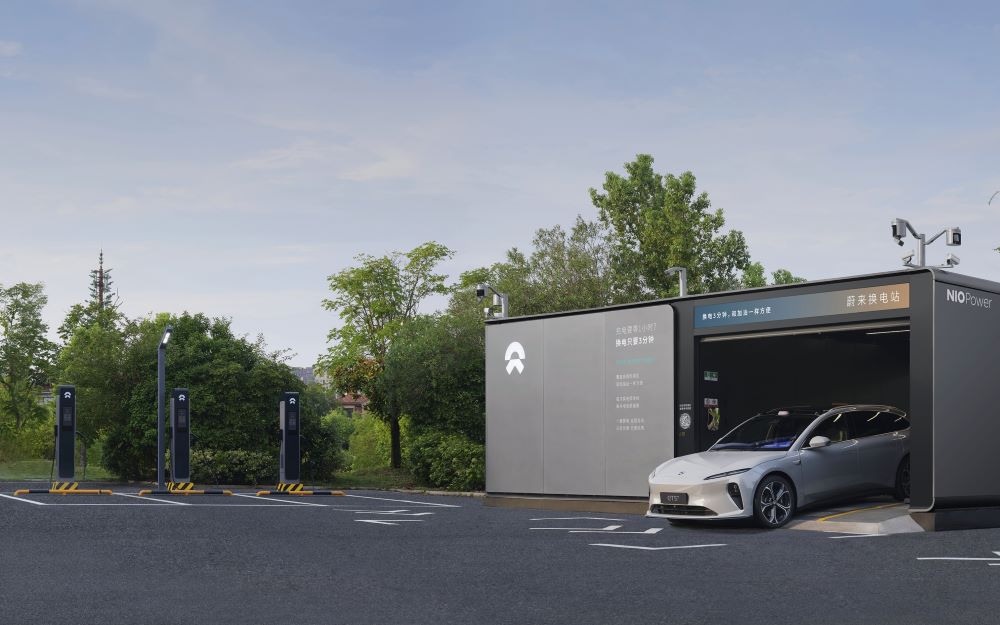
Geely will bring its commercial-vehicle swapping operations into the partnership, giving Nio access to high-frequency use cases such as taxis and ride-hailing vehicles.
Nio, meanwhile, will contribute charging assets to the shared network.
Geely plans to build more than 22,000 charging stations by the end of 2027, while Nio aims to have 10,000 battery-swapping stations by 2030.
Expanding a shared network
The cross-shareholding gives both companies a financial stake in the other side’s energy business and could make it easier to expand a shared network across different vehicle brands.
For Nio, the deal also brings 640 million yuan in fresh capital and additional commercial-vehicle demand to its energy business.
For Geely, it provides access to Nio’s battery-swapping network and operating experience without having to build a separate system from scratch.
The bigger question is whether the partnership can help battery swapping move beyond Nio’s own vehicles and develop into a shared infrastructure model for multiple brands.
Header image: Nio

.jpg)