
- The 6-billion-parameter model is trained on more than 5 million samples and about 2,500 hours of real-world robot data
- The move could give developers a cheaper way to build on embodied AI while helping Unitree secure a role at the technology’s foundation layer
Unitree has fully open-sourced its latest general-purpose humanoid robot foundation model, UnifoLM-WLA-1.0, including its code, model weights and training dataset.
This move comes as the Chinese robotics maker seeks to push deeper into the underlying software stack for embodied AI.
The company announced the release on September 10, saying the 6-billion-parameter model was trained on more than 5 million embodied-reasoning samples and about 2,500 hours of high-quality data collected from physical robots.

Dubious inconsistency
In real-robot tests, a single model can handle 64 tasks spanning desktop manipulation and whole-body mobile operations, while generalizing across tasks and end effectors. It supports parallel grippers as well as various five-finger dexterous hands.
Unitree said the model combines embodied reasoning, future dynamic-region prediction and discrete action learning in a single multimodal framework to improve spatial perception, interaction prediction and action generation.
The company said UnifoLM-WLA-1.0 ranked ahead of other open-source models in seven benchmarks and matched leading closed-source models.
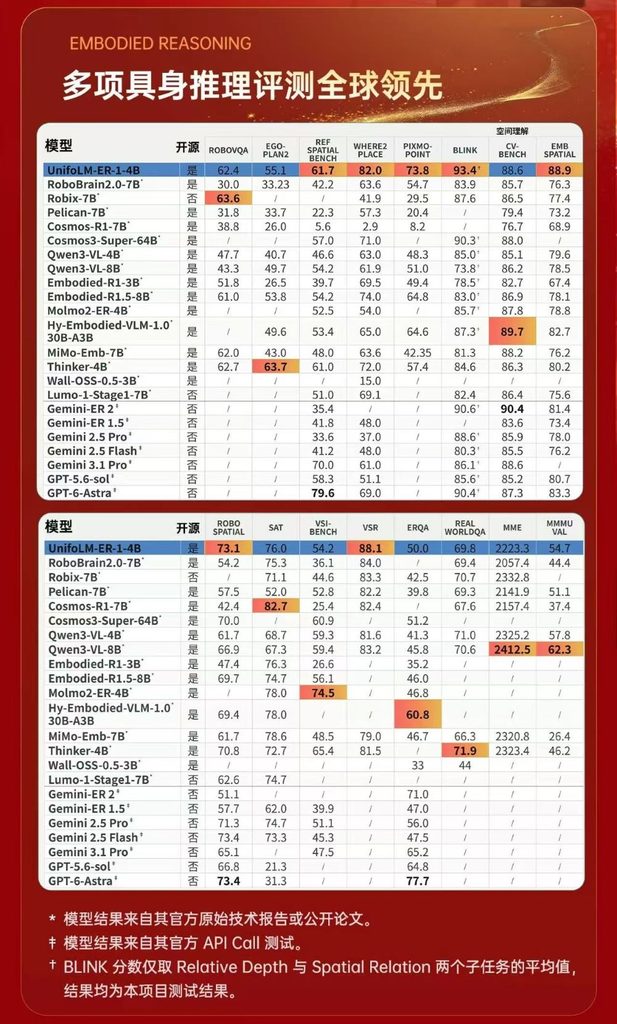
But the leaderboard in Unitree’s official WeChat posting shows UnifoLM-ER-1-4B in first place, rather than UnifoLM-WLA-1.0, raising questions over which model the “state-of-the-art” claim applies to.
The Yangtzeer asked Unitree about the discrepancy on its official social-media account but had received no response as of publication.
Data is the bigger deal
The release is notable less for open-sourcing model weights — which has become increasingly common in embodied AI — than for opening up roughly 2,500 hours of real-world robot data.
Collecting such data is expensive and time-consuming. A physical robot may generate only a few hours of usable operation data a day, much of which must then be cleaned, aligned and labeled.
For overseas developers, access to Unitree’s dataset could lower the barrier to building embodied-AI systems by allowing them to fine-tune models or experiment with new architectures without starting their data collection from scratch.
Underlying execution layer
For rival robotics companies, the move could also be strategically significant. As foundation models increasingly become the software layer between general-purpose AI and physical robots, Unitree is positioning itself in the underlying execution layer rather than relying solely on hardware sales.
In a more practical division of labor, large general-purpose models handle semantic understanding and task planning, while embodied models translate those plans into physical actions. UnifoLM-WLA-1.0 targets that lower layer.
Header image credit: Unitree’s official WeChat