
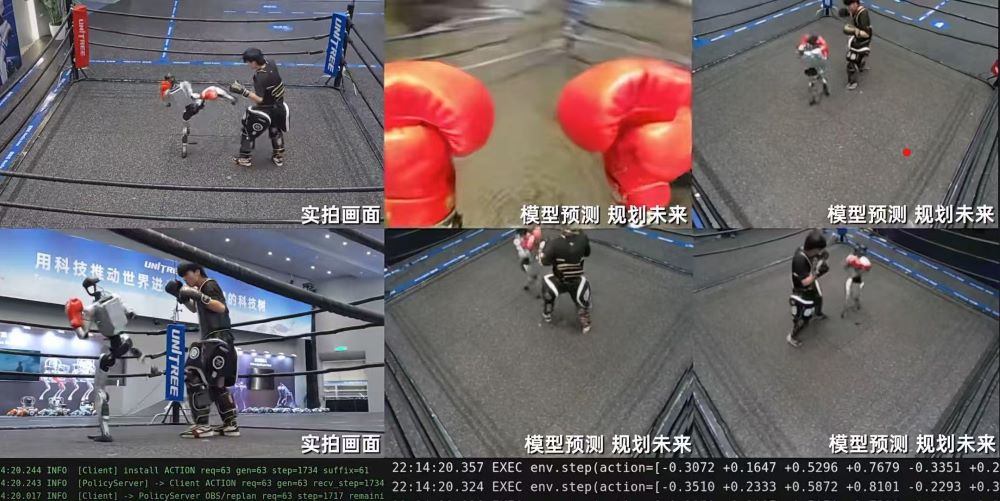
- The Chinese robot maker says its latest model can predict, plan and react to an opponent in real time without preset moves or remote control
- The breakthrough marks a push into the ‘brain’ of robotics after Unitree built its reputation on highly dynamic motion control
Unitree, a leading humanoid robot developer, has demonstrated what it calls fully autonomous humanoid-robot fighting, using its UnifoLM-X2-1.0 world model to predict and respond to an opponent in real time.
In a video released on September 7, the Chinese robotics company said it had achieved the world’s first fully autonomous human-to-humanoid fight, with a humanoid robot powered by its world model rather than preset moves or remote control.
Unitree said the model overcomes bottlenecks in real-time planning, decision-making and dynamic interaction.
The video shows Unitree’s G1 tracking its human opponent around the ring and landing punches and kicks with apparent accuracy, rather than blindly swinging or kicking at empty space when the target moves out of view.
The key change is the use of a world model. Rather than simply executing pre-programmed movements frame by frame, the robot builds an internal predictive representation of the physical world, allowing it to anticipate an opponent’s movements and adjust its actions accordingly.
Unitree’s G1 humanoid has appeared on fighting stages several times before, but those demonstrations relied on pre-programmed movements or teleoperation.
The new system is intended to demonstrate a higher level of autonomy in an unpredictable, highly interactive environment.
Unitree founder Wang Xingxing said in a WeChat posting that the system currently uses “very little data,” adding that he was curious to see what would happen as the model and dataset grow.
Neither he nor the company, however, disclosed the parameters of the proprietary world action model featured in the video.
VLA and WAM
The breakthrough also comes as Unitree is plowing substantial resources into advanced vision-language-action (VLA) systems and world action models (WAMs).
Its IPO filings show that about 2.022 billion yuan ($300 million) of its planned net fundraising of 5.917 billion yuan is earmarked for large-model and embodied-model development, or roughly 34% of the total.
The project covers two major approaches: a world-action model and a vision-language-action model, both aimed at improving the robot’s perception, decision-making and control.
That is an important shift for Unitree, now a listed firm on China’s Nasdaq-style STAR Market. The company has long been known for its strength in motion control — the robot’s “cerebellum” — while its development of the “brain” has lagged some domestic and overseas rivals.
Surviving a reality check? Not yet.
Unitree’s G1 has already appeared in overseas rental markets at rates of about $3,000 a day for events and exhibitions, but its role has largely been that of a robotic performer rather than a productive machine.
The new demonstration points toward a different direction. Autonomous decision-making and dynamic interaction are fundamental capabilities for robots that must work in environments such as industrial assembly, inspection and specialized operations.
But a fighting demo is still a long way from proving that those capabilities can deliver commercial value, such as performing day-to-day tasks in a home or factory setting.
The real test will be whether the intelligence demonstrated in the ring can move beyond a controlled showcase and become reliable enough to do practical work — and eventually show up in the company’s revenue.
Header image: Screenshot from Unitree’s video

