- Investors are pouring money into frontier technologies from embodied intelligence and brain-computer interfaces to quantum computing and AI chips
- The latest deals highlight startups moving closer to commercialization across robotics, chips, aviation and next-generation computing
Discover Robotics closes $100 million angel+ round to scale consumer robots
Wuxi-based consumer embodied AI robotics company Discover Robotics (求之科技) has completed a $100 million angel+ round, less than a month after closing its first angel round of more than $100 million.
The latest financing was backed by IDG Capital, LinkX Capital, Summitview Capital, Fortune Capital, Joyoung, Meridian Capital and Wuxi Binhu Industry Group, with all existing investors participating again. The deal has officially elevated the company to unicorn status.

Incubated by Tsinghua University’s Institute for AI Industry Research, Discover Robotics is led by a team with more than a decade of experience in intelligent robotics R&D and large-scale product deployment.
The team has previously led the product development and commercialization of multiple consumer robots from concept to mass production.
The company has built a full-stack “model-data-simulation” technology platform, including its hierarchical embodied AI foundation model Orion, virtual-real hybrid data loop system Loop and high-fidelity simulator Discoverse.
The technologies aim to address two major bottlenecks in embodied AI: limited real-world training data and the difficulty of transferring simulation capabilities into physical environments.
Its first consumer home service robot has completed engineering prototype validation and is scheduled for market launch in 2027. The new funding will support mass production, global channel expansion and continued development of its embodied AI foundation models.
Active Intelligence raises $49 million to advance invasive BCI technology
Shanghai-based invasive brain-computer interface company Active Intelligence Technologies (主动科技) has secured 330 million ($49 million) in angel financing led by CAS Star, with participation from Legend Star, Unity Ventures, Dalton Venture, Innoangel Fund, BGI-Green Pine Biotech Fund, Jifeng Ventures and Jiadao Capital.
The funding will support facility expansion, equipment upgrades, clinical trials and team growth, accelerating the commercialization of invasive BCI products.
Founded in 2024, the company’s core team comes from leading global BCI research institutions and medical device companies, with expertise in high-density microelectrode arrays, neural signal decoding algorithms and implantable medical device engineering.
Its self-developed high-throughput flexible electrode implantation system has completed animal testing, with key indicators including signal acquisition channels and long-term implantation stability reaching international advanced levels.
The technology aims to provide new treatment options for patients with paralysis, Parkinson’s disease and other neurological disorders.
Active Intelligence plans to submit its first product for clinical trial approval within the next 18 months, with the latest funding supporting GMP production line construction and preclinical safety evaluation.
Chipmaker Blue Wave snags Series A+ funding, surpasses $133 million in total financing
Hangzhou-based cellular communication chip developer Blue Wave Semiconductor (必博半导体) has completed a Series A+ round, bringing its total funding to more than 900 million yuan ($133 million).
The round was backed by Wuhan Hi-Tech Investment, Chengdu Future Ventures, Jiande State Investment and strategic investors including Transfar Group, Xinhua Chemical, Toread Holdings and ZJKF Capital.
Founded in 2021, Blue Wave is led by chairman and CEO Li Junqiang, a Tsinghua University graduate with 25 years of experience in communication chip development. He previously led the design of multiple mass-produced communication chips.

The company focuses on 5G/6G communications, broadband low-orbit satellite communications and the integration of cellular connectivity with edge AI.
Its first 5G RedCap chip has completed tape-out validation, with performance comparable to international competitors. The chip targets low-power wide-area applications including industrial IoT, connected vehicles and wearable devices.
The new funding will support production ramp-up, market expansion and next-generation chip development. Blue Wave has established strategic partnerships with major module makers and terminal device manufacturers, and expects large-scale shipments by 2027.
Unitary Quantum raises Series A funding to accelerate ion-trap quantum computing
Hefei-based ion-trap quantum computing company Unitary Quantum (幺正量子) has completed a Series A round worth hundreds of millions of yuan.
The latest funding was led by Shenzhen Capital Group and joined by investors including Social Security Fund Greater Bay Area Tech Innovation Venture Fund, GF Xinde Investment, Jingming Capital, Puhua Capital, Xingtai Capital, Fortune Capital and GCL Energy Technology.
The company was incubated from the team of Chinese Academy of Sciences academician Guo Guangcan at the University of Science and Technology of China and is one of China’s leading companies pursuing the QCCD ion-trap quantum computing architecture.
Unitary Quantum has completed Quantum Volume 32 benchmark testing, bringing its full-stack system performance to an internationally advanced level.
It is also undertaking major provincial research projects and became the first Chinese quantum computing company to achieve both low-temperature ion trapping and ion transport.
The company combines trapped-ion chains with optical tweezer arrays while developing proprietary ion-trap chip designs and cryogenic vacuum systems, building capabilities from underlying physics to quantum algorithms.
Coming less than four months after its pre-Series A round, the new financing will support research into quantum advantage and error correction. The company aims to build a 100-qubit prototype machine before 2027 and open its cloud platform to research institutions and financial companies.
EVT Aerotechnics completes Series A+ round for eVTOL commercialization
Nanjing-based eVTOL developer and manufacturer EVT Aerotechnics (亿维特航空) has completed a Series A+ financing round worth hundreds of millions of yuan, backed by Shangcheng Capital and Puhua Capital.
The company’s core team comes from Commercial Aircraft Corporation of China (COMAC), with an average of more than 15 years of aviation experience and involvement in major aircraft programs including the C919 and ARJ21.
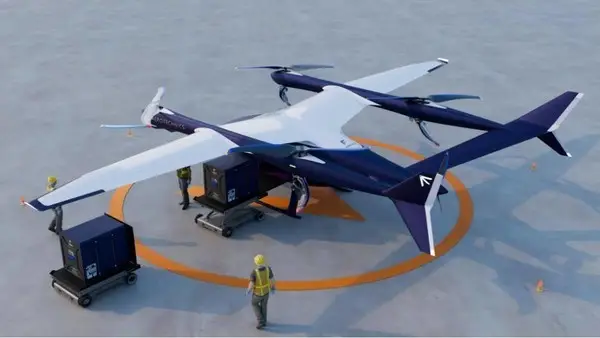
EVT’s product lineup includes the ET9 passenger and cargo variants as well as the ET3 hydrogen-lithium hybrid model. The company adopts a compound-wing configuration designed to balance range, payload capacity and takeoff-and-landing flexibility.
The ET9 has a designed range of 250 kilometers, targeting intercity mobility within urban clusters. The company has secured more than 890 potential orders and partnered with Didi to explore commercial “air taxi” operations.
The new funding will support airworthiness certification and commercialization. The ET9 cargo version has completed its maiden flight, while the passenger version is expected to obtain type certification (TC) in 2027, potentially making EVT one of China’s first eVTOL companies to enter commercial operations.
AI processor unicorn LuminNX secures Series A1 funding at nearly $1.5 billion valuation
Shanghai-based AI chip and system architecture developer LuminNX (昉擎科技) has completed its Series A1 financing round, pushing its valuation above 10 billion yuan ($1.48 billion) and making it a unicorn.
The round was led by Xuhui Capital and Zhuhai Technology Industry Group, with participation from CICC Capital, Guotai Haitong Securities Capital, Shangshi Fund and Tsinghua Innovation Ventures. Existing investors including Peakvest, InvesTarget, HyT Capital and Lingang LKC Investment also increased their stakes.

LuminNX has proposed a distributed computing architecture that separates context-dependent and context-independent workloads, aiming to reshape AI computing for the low-latency token demands of Agent applications.
Its proprietary chips combine heterogeneous computing and in-memory computing technologies, delivering more than 10 times higher energy efficiency in typical inference scenarios, according to the company. It has also secured multiple core patents.
The company is developing a complete ecosystem spanning chips, software stacks and developer tools, with deep compatibility with mainstream AI frameworks.
The new funding will support chip and system R&D, mass production, software ecosystem development and talent recruitment. Its first chip is scheduled for tape-out in 2027, with preliminary cooperation discussions underway with major cloud providers and computing infrastructure operators.
Scietrain announces Series B+ round to scale native multimodal AI
Hangzhou-based large model developer Scietrain (西湖心辰) has completed a Series B+ funding round worth several hundred million yuan, led by GF Xinde Fund, with participation from Westlake Innovation Capital, Wuhan Porpoise Fund, Winreal Investment and Nantong Asset Investment.
Industry investors including recruitment platform Liepin’s corporate venture arm and Pegasus Capital also joined, while existing backers Ant Group and Jinke continued their support.
Founded in 2021 and incubated by Westlake University, Scietrain is led by CEO Lan Zhenzhong (蓝振忠), a doctoral supervisor at Westlake University and head of Ant Group’s General AI Center.
The company focuses on native multimodal large models based on diffusion architectures, targeting real-time interactive applications.
Its proprietary model combines long-term memory and emotional perception capabilities and has been deployed in products including psychological companion app “Liaohui Xiaotian,” literally “Have a little chat,” which has served more than 100,000 users, as well as Jinke’s AI voice companion robots.
The company has also expanded into global markets since 2024. The new funding will support next-generation diffusion language model development, product iteration and further overseas expansion.