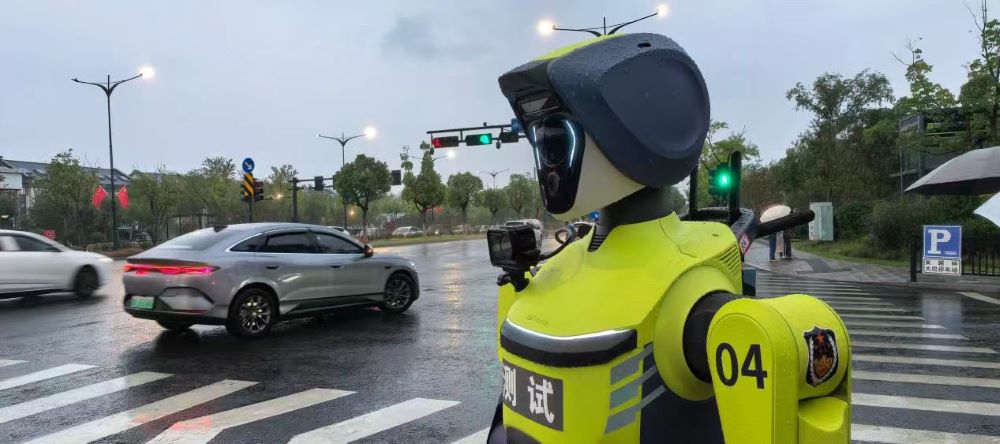
- The robot-dog maker is testing its humanoid in one of the most unpredictable environments: a busy public street
- The move gives DEEP Robotics a new way to test human-robot interaction as it expands beyond quadrupeds
DEEP Robotics (云深处科技), a major quadrupedal robot developer, has put humanoid robots on traffic-duty tests in Hangzhou, sending several of its machines onto public streets on October 4 to direct traffic and answer questions from pedestrians.
The move marks the first time the Hangzhou-based company has deployed its humanoid robots on public streets, a notable step for a company best known for quadruped robots. DEEP Robotics has produced more than 5,500 robots to date.
From robot dogs to humanoids
Humanoid robots acting as traffic officers are no longer unusual in China. Hangzhou’s West Lake area deployed 15 wheeled robots in May to identify violations such as riding without helmets and illegal parking.
Shenzhen’s Longgang district put robot traffic officers to work in March, while a humanoid robot called Tianyi (天轶) helped direct runners at a marathon in Beijing’s Yizhuang industrial park in April.
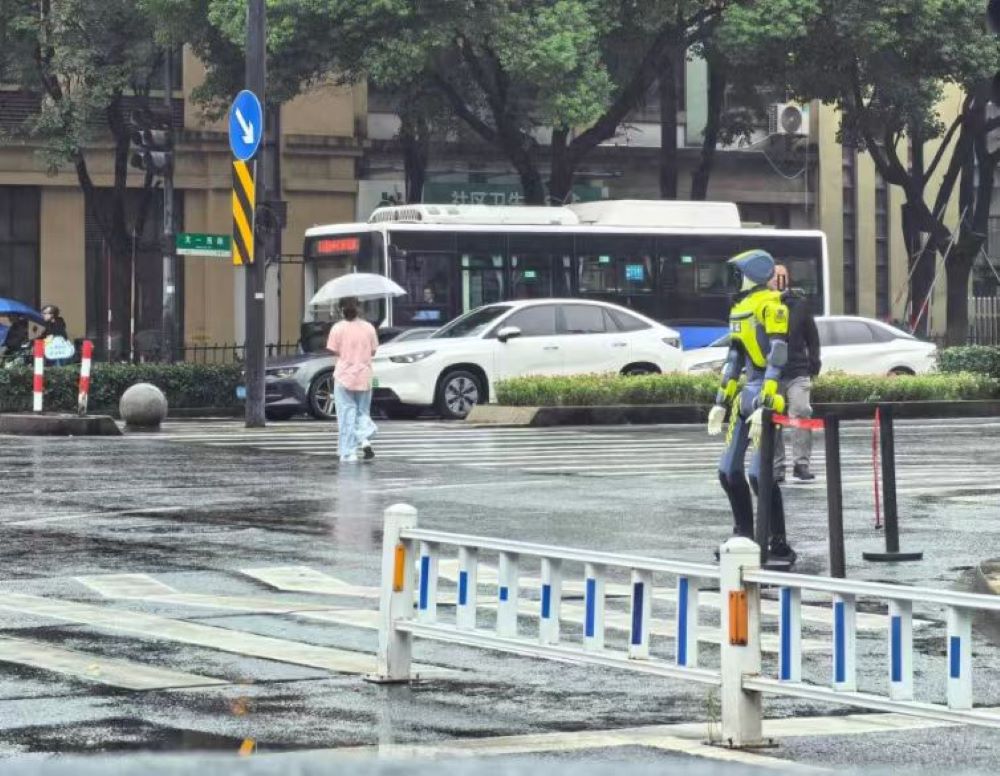
But DR02 is different from most of the robot traffic officers that came before it. It is a bipedal humanoid designed to move on two legs, rather than a wheeled platform.
That gives DEEP Robotics a chance to test whether a more human-like form can handle the uneven, unpredictable conditions of public streets while interacting directly with pedestrians.
DEEP Robotics, however, has until recently focused on quadruped and wheeled-legged robots, including its X-series robot dogs and Lynx M-series machines. Its DR02 humanoid entered commercial rollout only in 2026.
The DR02 is designed as an all-weather industrial robot, with an IP66 rating and an operating temperature range of -20 C to 55 C.
Its target applications include power inspection, hazardous-chemical operations and emergency response — environments where endurance and reliability matter more than human interaction.
Traffic duty offers a very different test.
Testing robots in the wild
The company says its “1+X+N” strategy uses real-world deployments to improve its embodied-intelligence systems. Putting DR02 on a public street exposes it to situations that are difficult to reproduce in a lab or factory.

Pedestrians can suddenly ask for directions. Electric bikes may ignore traffic rules. Rain can affect sensors and perception. These are precisely the unpredictable, long-tail interactions that humanoid robots must eventually handle if they are to work alongside people.
The street deployment also gives DEEP Robotics a relatively accessible commercial testing ground. Government-backed urban applications can provide defined operating environments and potentially repeatable deployment scenarios, while generating real-world data for future iterations.
That matters as the company expands beyond its established quadruped business.
The deeper backdrop is commercialization pressure. DEEP Robotics’ revenue jumped more than 117% to 259 million yuan in the first half of 2026, but the company swung back to a net loss of 8.81 million yuan attributable to shareholders. Its research and development spending surged more than 140% during the period.
Humanoids are its next big bet, but industrial customers often face long procurement cycles and slow decision-making.
Urban management such as traffic direction offers a relatively accessible entry point: governments have budgets, the scenarios can be replicated, and the data can feed back into the robots’ models.
The company is also preparing for a Shanghai STAR Market listing and plans to raise 2.5 billion yuan, adding pressure to demonstrate that its humanoid business can develop beyond prototypes and demonstrations.
Real-world viability
For DEEP Robotics, the traffic deployment is therefore less about replacing human traffic officers today than about testing what its humanoids can learn from operating in the real world.
The more important question is whether those lessons can eventually turn DR02 from a robot that can walk onto a robot that can reliably work.
Header image credit: DEEP Robotics official WeChat