- The eastern Hangzhou district of Linping wants to become a one-stop marketplace for the motors, sensors, chips and batteries needed to build humanoid robots
- Its bet is that in an industry racing toward mass production, the fastest supply chain may matter almost as much as the best technology
The next Huaqiangbei (华强北) may not be in Shenzhen. It could be thousands of miles away in eastern Hangzhou.
Linping (临平), an industrial district on the city’s eastern edge, wants to become the “Huaqiangbei of embodied intelligence” — a one-stop hub where robot makers can source motors, sensors, chips, batteries and other core components, develop prototypes and move quickly into production.
Huaqiangbei, Shenzhen’s sprawling electronics district, became famous for putting component suppliers, manufacturers and engineers within easy reach of one another, making it easier for consumer-electronics companies to source parts and build products.
Its advantage is not simply low prices, but speed: a company can find a part, build a prototype, change the design and source another batch with minimal delay.
Linping wants to bring that model to robotics.
Why start with components?
The district formally unveiled its plan on September 1, focusing on four areas: precision transmission and actuators, intelligent sensing, advanced structural materials and robot batteries.
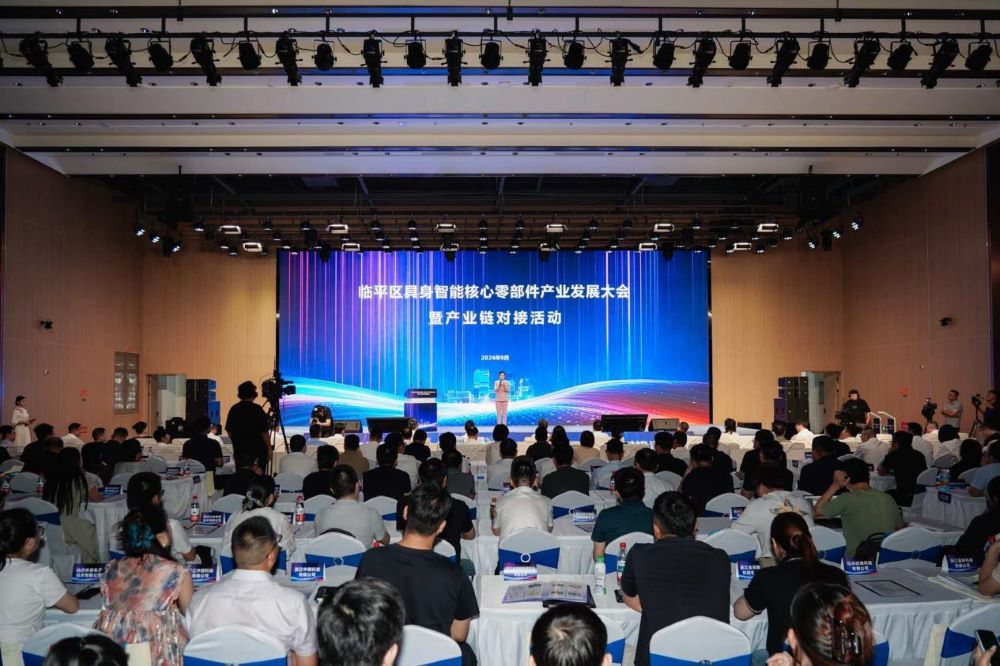
It aims to build a cluster generating more than 10 billion yuan ($1.5 billion) in annual output by 2028, with a longer-term target of 15 billion yuan.
The strategy reflects a simple reality: building a humanoid robot requires far more than an AI model and a body.
Precision reducers and servo motors control movement; vision chips and tactile sensors give robots perception; batteries determine how long they can work.
Linping already has more than 100 companies working on such components. They include Weiguang (微光电子), a servo-motor maker; NextVPU (肇观电子), which develops VPU vision chips; Cobotact (慧感智能), a force and tactile-sensor company; and Golden Feather (金羽新能), which makes high-energy-density batteries.
The district also has a substantial industrial base, with 814 industrial companies whose annual main-business revenue reach or exceed 20 million yuan generating 184.94 billion yuan in output in 2025.
It is home to 30 listed companies and has one of Zhejiang’s largest concentrations of “future factories.”
Speed may be the real product
For Linping, the bigger bet is that robotics will reward supply chains that can respond as quickly as robot designs evolve.

The district is working with Zhejiang University, City University of Hong Kong and Zhejiang University of Technology on component technologies and has launched a public-service platform for embodied-intelligence components.
Its dedicated embodied-intelligence industrial park now houses 17 companies spanning chips, sensors and autonomous driving algorithms.
Linping has also introduced support for small and urgent orders — a practical problem for robotics startups that need dozens of customized parts rather than the large batches traditionally preferred by component suppliers.
That could become important as humanoid robots move from prototypes toward mass production.
A robot maker may need to change a motor, sensor or battery after testing a new design. The supplier that can deliver the replacement fastest will save weeks of development time.
The race is already crowded
Linping is not alone in its bid to build a cluster around embodied intelligence. Shanghai’s Maqiao AI Innovation Pilot Zone (上海马桥人工智能创新试验区) has more than 150 embodied-intelligence companies, while Suzhou, Dongguan, Shenzhen and other manufacturing centers already have deep robotics supply chains.
That makes Linping’s challenge clear: it must offer more than another industrial park.
Its ambition is to compress the path from “I need this component” to “I have a working prototype.”
If it can make that happen, Linping could become more than a local robotics cluster. It could evolve into another important node in China’s — and potentially the world’s — increasingly competitive supply chain for embodied intelligence.
Header image generated by Doubao