- Wang Xingxing says robots could soon learn, test and improve their own skills with little help from human engineers
- The Unitree founder also set a “double-80%” threshold for when embodied AI could reach a ChatGPT-like breakthrough
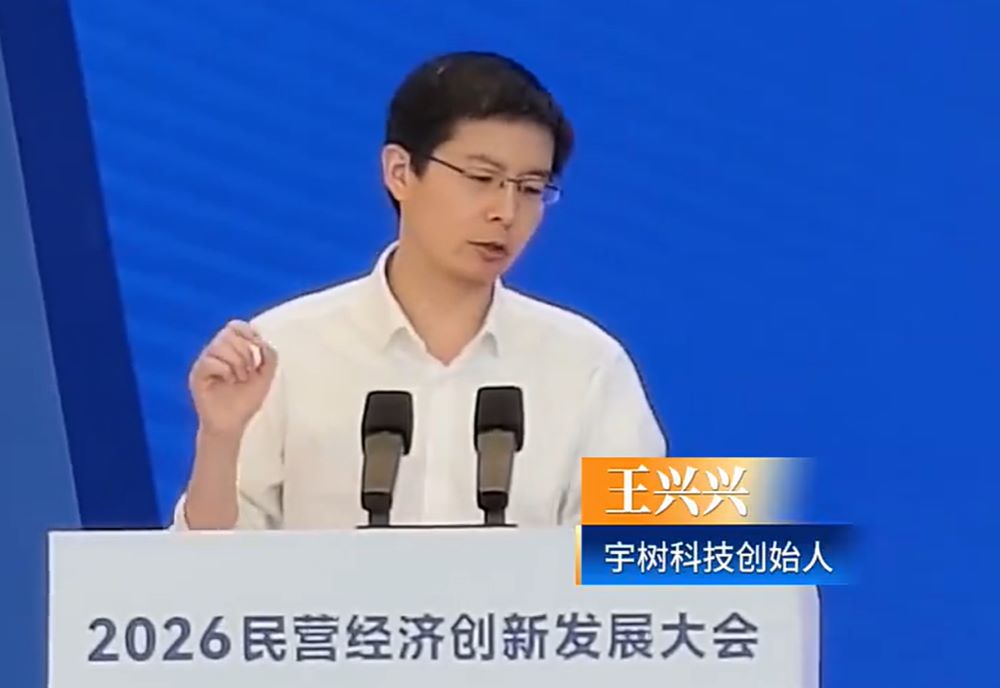
The next major step for humanoid robots will be self-evolution, Unitree founder and CEO Wang Xingxing (王兴兴) said at a major innovation conference yesterday.
Speaking at the 2026 Private Economy Innovation Development Conference held in Wenzhou on September 9, Wang explained that self-evolution would allow robots to improve their own capabilities with minimal human intervention.
Addressing a room full of private-sector entrepreneurs, he described a closed-loop system that would allow an AI model to search the latest research papers, generate control programs, validate them in simulation and then deploy them on real robots.
The results would be evaluated by both software and human engineers, with the feedback fed back into the next iteration, the 36-year-old founder said.
The goal, according to him, is to replace today’s labor-intensive development process with a computing-intensive one.
Instead of relying on engineers to manually program and test every new skill, thousands of robots could run experiments in parallel, with computing power and electricity accelerating the learning process.
“Within the next one to two years, we will truly begin the self-evolution cycle for physical AI,” Wang said.
The ‘double-80%’ test
Wang also offered a quantitative benchmark for when humanoid robots could reach a form of general intelligence.
He said the breakthrough would come when a robot can enter 80% of unfamiliar environments and autonomously complete 80% of everyday tasks using only voice or text instructions.

He expects that “ChatGPT moment” in embodied intelligence to arrive in as little as two to three years, though it could take five to 10 years. Wang made similar comments on many previous occasions.
According to Chinese media reports, the remarks were his first major public appearance in his home province of Zhejiang since Unitree went public on Shanghai’s STAR Market in August. Wang is a native of Yuyao, a county-level city governed by Ningbo.
Closing the gap between AI and the physical world
Wang said the biggest obstacle facing embodied AI is the accumulated error between what an AI model perceives and decides and what a physical robot actually does.
A large language model operating in a digital environment can execute instructions with relatively little physical loss. A robot, by contrast, introduces errors at every stage — from sensing and decision-making to physical execution.
Even an error of a few centimeters can matter, while a deviation of just a few millimeters during a manipulation task can cause the entire task to fail, he noted.
That, Wang said, is why robots can already “run and jump but still can’t get work done.”
His proposed self-evolution system would effectively shift robot development from a human-intensive process to a compute-intensive one, potentially allowing new skills to be developed and validated much faster.
Implications for China and beyond
For China’s robotics industry, the approach also represents a distinct technological bet.
Rather than focusing solely on improving motion control or deploying humanoids in factories, Unitree is betting that increasingly capable foundation models and automated experimentation can help solve the broader problem of robot generalization.
But the system remains largely a research proposition. Whether thousands of robots can actually generate sufficient useful data, discover better control strategies and reliably transfer those improvements from simulation to the physical world remains unproven.
Wang’s vision therefore offers an ambitious direction for the industry — but not yet a proven roadmap.
A reality check
Unitree’s stock performance on September 9 offered a more immediate reality check.
The shares fell 1.86% to 513.93 yuan ($76.62) as of yesterday’s trading, putting the company’s market capitalization at 208 billion yuan.
That was roughly 53% below its post-listing peak of about 445 billion yuan, wiping out nearly 237 billion yuan in market value.
Header image is a screenshot from the video of Wang’s speech