- SenseMartGo stores in Shanghai nearly doubled transactions during the National Day holiday
- But scaling to thousands of stores could make maintenance and repair a bigger problem than attracting customers
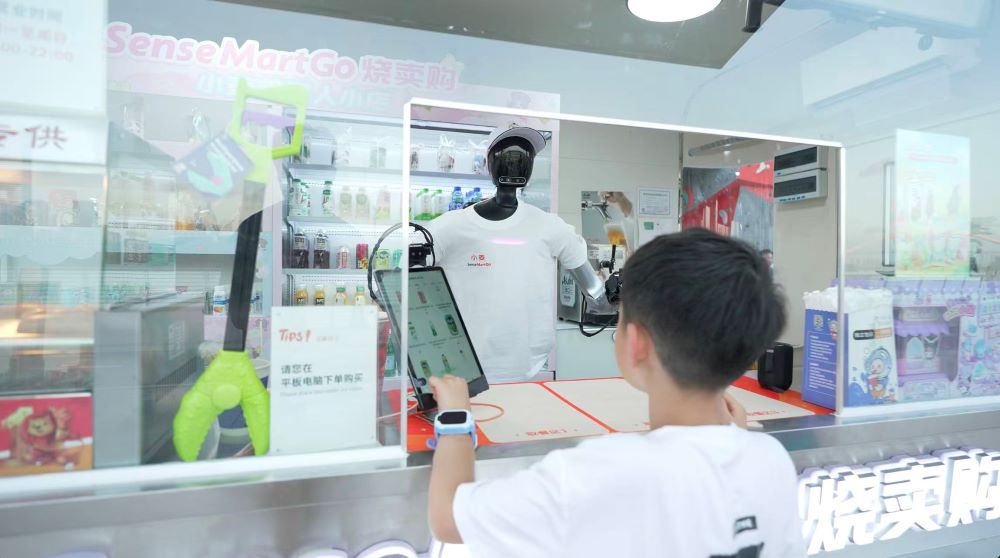
SenseMartGo (烧卖购), a robot convenience-store brand launched by SenseTime’s retail arm SenseMart (商汤善惠), saw transactions at its Shanghai stores nearly double from normal levels during China’s weeklong National Day holiday.
Its Baoshan Riverside store in suburban Shanghai’s Baoshan District recorded the biggest jump during the “golden week” period, with transactions rising more than 25-fold from the previous week.
Robots take over the store
SenseMartGo stores operate without human clerks. A robot handles tasks ranging from greeting customers and recommending products to retrieving goods, restocking shelves and making coffee and ice cream.
At peak times, an order can be completed in as little as 15 seconds. The chain now has more than 20 stores across Shanghai, Hefei, Shenzhen, Qingdao and Yancheng.
The economics are central to the model. SenseMart says each store requires an average of just 0.2 to 0.3 employees, with one operator able to support three to five stores. A traditional convenience store typically needs two employees working in shifts.
Payback period
For well-located stores in Shanghai, SenseMart estimates a payback period of about six months to one year.
The company has also found little evidence so far that opening stores close together simply shifts customers from one location to another.
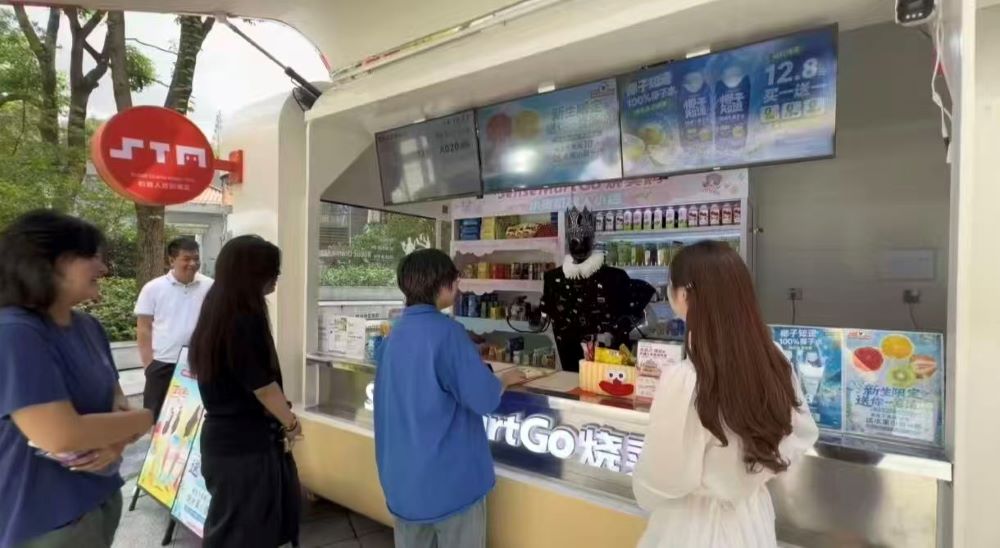
Two SenseMartGo stores along Shanghai’s Xuhui waterfront are just 30 to 50 meters apart. The team initially worried that the second store would cannibalize sales at the first. Instead, combined sales from the two stores reached about twice the level of the original store alone.
“That shows service supply in these areas is still far from enough,” said Yi Shuai (伊帅), co-founder of SenseMart.
The repair problem
But moving from more than 20 stores to the company’s ambition of thousands of stores across hundreds of cities presents a problem that may be harder than attracting customers: What happens when the robots break down?
Yi acknowledged that robot maintenance has yet to reach the maturity of repair services for conventional equipment such as air conditioners and televisions. There is no equivalent of a technician who can quickly show up and fix a malfunctioning robot.
That could become a bigger issue as the network expands. Hardware wear, spare-parts inventories and repair logistics all become more complicated as the number of stores rises.
Problems that can be handled manually across a few dozen locations could start affecting operating costs and returns when the network reaches hundreds or thousands of stores.
The National Day holiday showed that robots can handle real retail traffic. The harder part is making sure they can keep doing the job cheaply and reliably enough to make a large-scale robot convenience-store network work.
Header image credit: SenseMart official WeChat