
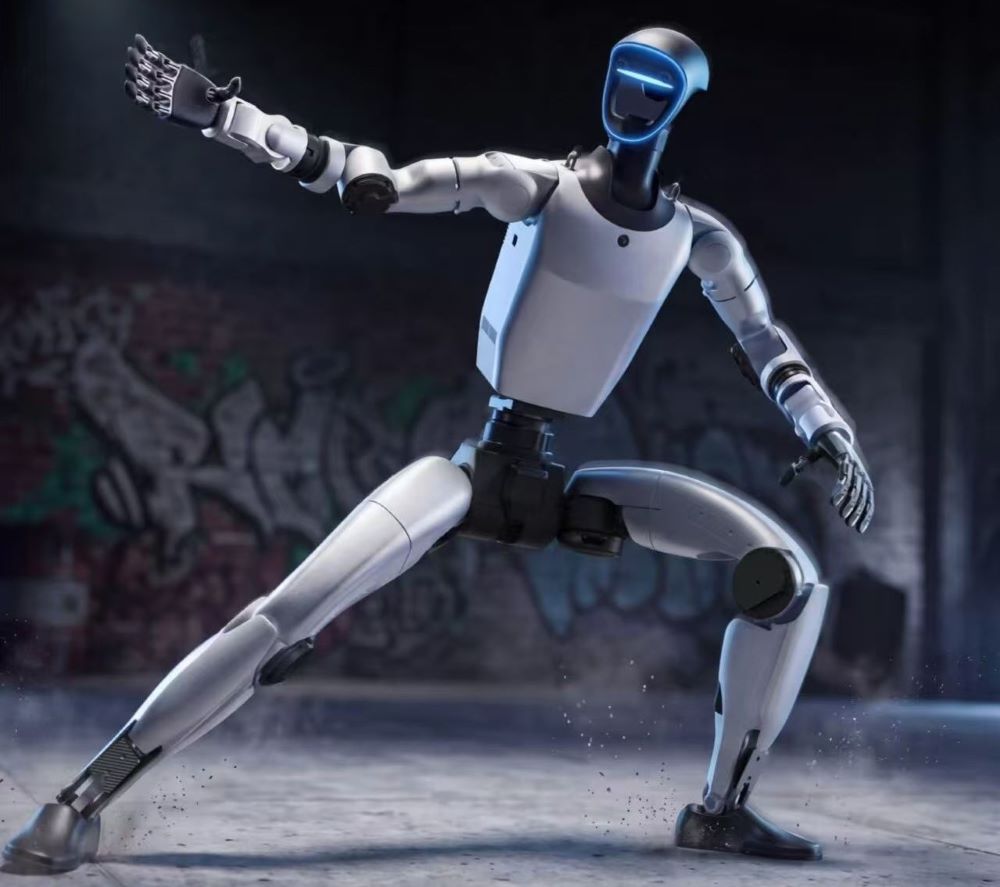
- The G1+ adds head movement, better sensing, touch interaction and external power
- The upgrade comes days after Unitree open-sourced its humanoid foundation model
Unitree on September 14 launched the G1+, an upgraded version of its flagship humanoid robot G1, adding a range of capabilities aimed at making the machine more useful in everyday human-robot interaction.
The standard G1+ is priced at 95,000 yuan ($14,164) including tax, while pricing for the G1+ EDU, an edition designed for research and development, has yet to be announced.
From rigid to responsive
The G1+ brings six upgrades across motion, perception and interaction. Its head now has two additional degrees of freedom, allowing it to tilt from about -25 degrees to 36 degrees and rotate up to ±110 degrees, making its movements more human-like.
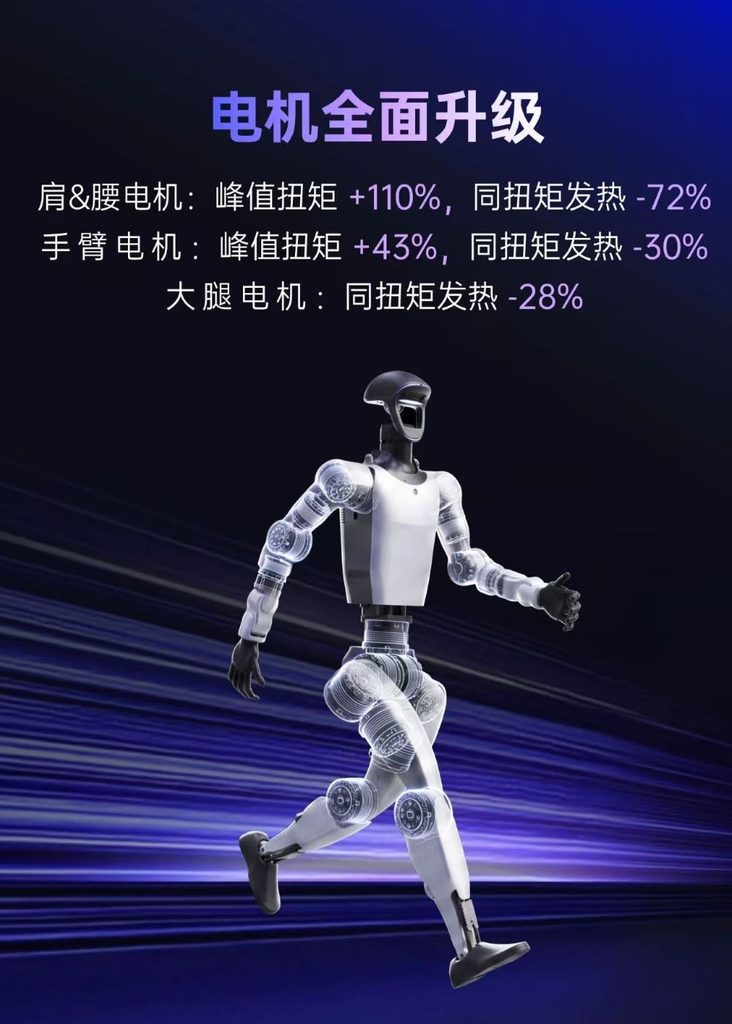
Peak torque from its shoulder and waist motors has increased 110%, while heat generation at the same torque level has fallen 72%.
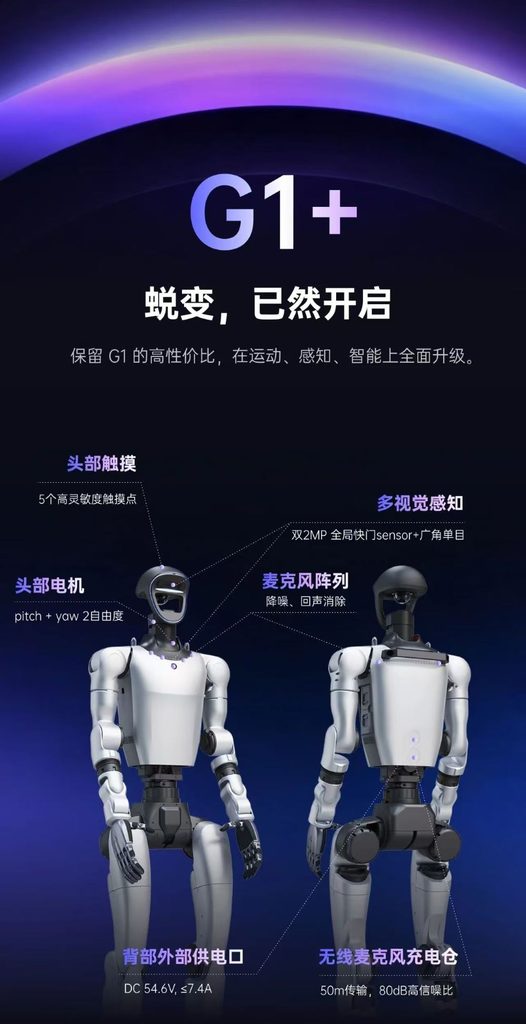
For perception, the robot uses a dual-vision system combining binocular and wide-angle monocular cameras, along with a 3D lidar and a wide-angle camera on its torso.
The head also has five touch points that can trigger a conversation with a light tap. A six-microphone array supports far-field voice pickup, sound-source localization and noise reduction.
An external power port on the back allows the G1+ to operate continuously without relying on its battery, a feature aimed at longer-duration deployments.
From robot to platform
The original G1 was launched in 2024 at 85,000 yuan and helped Unitree become the world’s top humanoid robot maker by shipments in 2025, with more than 5,500 units sold, according to the company.
It also became the star of many of Unitree’s demonstrations, overtaking the company’s first-generation H1 as its most recognizable humanoid model.
But the G1’s fixed head and limited interaction capabilities made it feel rigid in scenarios requiring human conversation and fine manipulation.
The G1+ focuses less on flashy movements than on basic interaction — turning its head, hearing voices, responding to touch and staying powered on for long periods.
At 95,000 yuan, the G1+ remains aggressively priced by global standards. Tesla has said Optimus could eventually cost less than $20,000, but the robot has yet to reach mass commercial delivery, leaving Unitree with an edge in production, pricing and shipments.
The G1+ also extends Unitree’s cost advantage. A breakdown by China Post Securities estimated the original G1’s bill of materials at about 41,600 yuan, implying a gross margin of roughly 40.7%.
More importantly, the hardware launch follows Unitree’s open-sourcing last week of its UnifoLM-WLA-1.0 humanoid foundation model.
Together, the two moves suggest Unitree is shifting from simply selling robots toward building a platform around affordable hardware and open AI models.
For overseas developers, that could mean a more capable hardware base at a relatively low price.
For rivals, the competition is increasingly moving beyond robot performance to a broader question: who can build a software-and-hardware ecosystem developers can afford to adopt and keep building on?
Header image credit: Unitree’s official WeChat

