

- The initiative brings universities, research institutes and technology companies together to develop computing infrastructure in orbit
- Participants include Fudan University, Shanghai Institute of Technical Physics, China Telecom, SenseTime, Biren Technology and more
China’s Xingshu Project (星枢计划), often dubbed the Chinese answer to SpaceX, has launched a collaboration initiative bringing together universities, research institutes and companies to develop an emerging space-computing industry.
The move comes two months after the project’s first satellite constellation was unveiled at the 2026 World Artificial Intelligence Conference in Shanghai.
The Xingshu Project Collaboration Initiative was released September 20 at a Shanghai forum on space computing innovation held at Fudan University.
All hands on deck
The initiative calls for joint work on satellite chips, in-orbit computing and AI models designed to run in space, as well as closer cooperation across satellite manufacturing, constellation operations and industry applications.
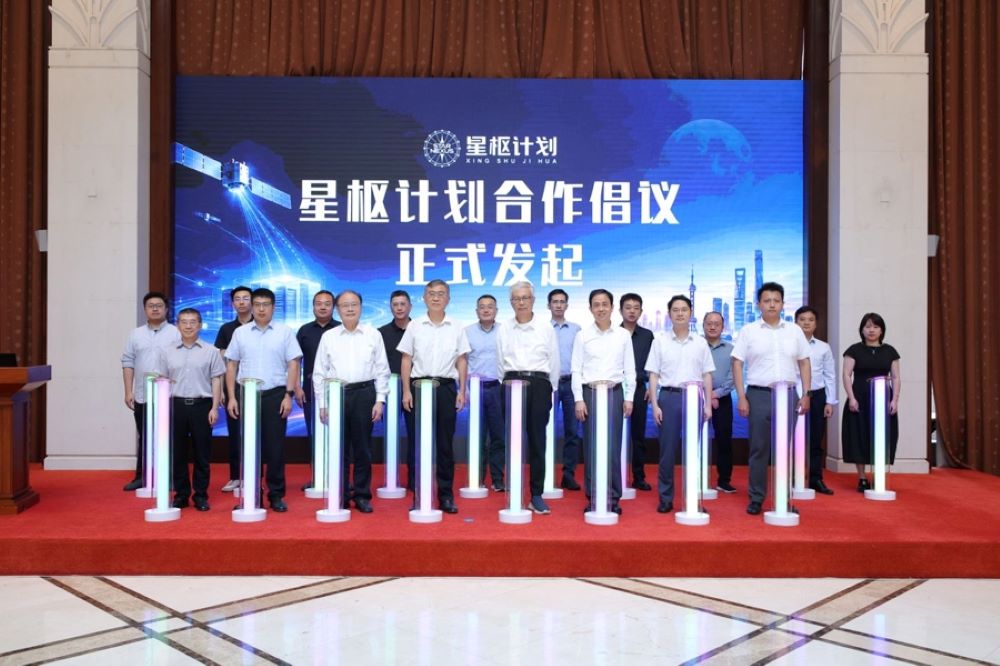
The initiative was jointly launched by three colleges and research institutes including Fudan University, the Shanghai Institute of Technical Physics of the Chinese Academy of Sciences and East China Normal University.
Other participants consist of industrial-chain players such as Orbital Voyager (巡天千河), Remo-Telight (星遥光宇), China Telecom Shanghai, SenseTime, Baidu AI Cloud (百度智能云), ZTE (中兴通讯), Biren Technology (壁仞科技), Iluvatar CoreX (天数智芯), Aerosource Spacetech (翮源空间) and Etherspace (太驿微行航天).
Government officials and academic experts also took part in the launch ceremony.
From project to ecosystem
The move marks a shift from developing the Xingshu Project itself toward building a broader industrial ecosystem around space-based computing.
The project was first publicly unveiled at the 2026 World Artificial Intelligence Conference in July, when Fudan University and Shanghai Xingshu Tiansuan Space Technology introduced its first three-satellite constellation.
The constellation consists of a central computing satellite, a Fuxi weather satellite and a real-time remote-sensing satellite, linked by laser communications.
Processing data in orbit
The idea is to move some data processing from Earth into orbit.
Instead of sending large volumes of raw satellite imagery to ground stations for analysis, satellites can process and filter data in orbit and transmit useful information — such as weather warnings, disaster assessments and shipping intelligence — back to Earth.
The initiative focuses on five areas: research, supply-chain integration, industry standards, commercial applications and talent development.
It calls for joint work on satellite chips, in-orbit computing and space-based AI, along with closer integration from chips and payloads to satellites and applications.
It also targets standards for satellite computing and inter-satellite communications, applications in disaster response, weather and resource monitoring, and training talent with expertise in both aerospace and AI.

Toward 1,000 satellites
Xingshu plans to expand its constellation in three stages, starting with engineering validation before moving to commercial deployment and eventually a 1,000-satellite network.
The initiative calls on participating organizations to establish a coordination mechanism and jointly develop the project’s first constellation and related applications.
The collaboration reflects an effort to connect technologies that have traditionally developed separately — from aerospace and satellite manufacturing to semiconductors, AI and cloud computing — around a common space-computing platform.
Header image credit: Zelch Csaba/Pexels

.jpg)