- The International Embodied Intelligence Competition will test robots in factories, warehouses, restaurants and other real-world settings
- Organizers will use blind testing, equipment failures and changing layouts to measure whether machines can actually get the job done
Shanghai will host an embodied-AI competition later this month that aims to move beyond robot demonstrations and test whether machines can perform useful work in real-world settings.
The 2026 Global Developer Pioneers Summit and International Embodied Intelligence Competition will run from October 23 to 25 at Zhangjiang Science Hall, with more than 200 teams and 300 robot makers expected to take part.
Under the theme “Embodied intelligence enters real-world scenarios,” the competition will feature nine tracks and 23 events covering manufacturing, inspection and maintenance, logistics, retail and catering, healthcare and emergency response.
Unlike conventional robotics competitions, the event will have no rehearsals or fixed scripts. Organizers will use “black-box blind testing,” randomly changing the placement of materials and introducing equipment faults during the events to see how robots respond.
Conducting real work
Competitors will be given tasks drawn from actual industrial and commercial operations, including grasping, assembly, inspection and delivery. They will have to complete the assignments within set time limits.
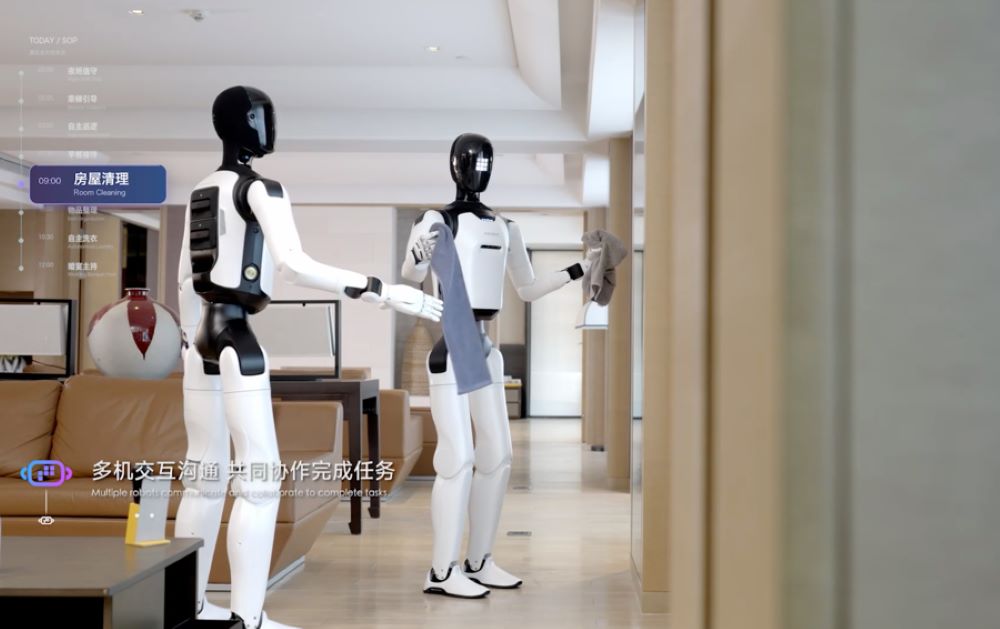
More than 200 teams have already registered, including robotics companies such as AgiBot (智元机器人), Unitree (宇树科技), ABB and Fourier (傅利叶), as well as state-owned companies including Shanghai Electric (上海电气), COSCO Shipping Technology (中远海科), State Grid (国家电网) and Bailian Group (百联集团).
Research teams from universities including Fudan University and Shanghai University will also participate, creating a mix of robot makers, industrial users and academic groups.
Zhong Junhao (钟俊浩), secretary-general of the Shanghai Artificial Intelligence Industry Association, said the event would use real-world training environments and standardized “skill packages” to evaluate complete robot solutions.
The assessment will focus on metrics including task success rates, efficiency gains, safety and reliability, as well as economic viability and potential return on investment.
“We are not looking at what robots can perform as a show,” Zhong said. “We want to see whether they can do the job well and generate value at a real workstation.”
A longer road to deployment
The competition will continue beyond the three-day event in Shanghai. The October 23-25 sessions will serve as simulated competitions, followed by online simulation contests and eventually real-world competitions at a steel mill in Beijing and a coal mine in Shanxi province.
The extended format reflects a broader push in China to move embodied AI from demonstrations into industrial applications.
Chinese local governments are increasingly looking for real-world environments where humanoids and other embodied-AI systems can be tested and deployed.
In June 2026, China’s Ministry of Industry and Information Technology and the State-owned Assets Supervision and Administration Commission launched a dedicated real-world training initiative that calls on each province and major municipality to select at least 20 real-world application scenarios.
The Shanghai competition is being positioned as part of that effort, with organizers seeking to identify 100 high-value application scenarios and eventually support the deployment of tens of thousands of robots.
The summit will also host developer-focused events covering foundation and world models, embodied-AI training and agent development, with sessions spanning developer communities, hands-on technology training and industrial applications.
For an industry still crowded with demonstrations of robots walking, dancing and manipulating objects, the competition is designed to ask a more commercial question: Can they do the work reliably enough to be worth paying for?
Header image: Poster of 2026 Global Developer Pioneers Summit